


You've done the math three times already. Two countries, ten days, one salary — and every flight search seems to push the total past what you're willing to spend. Here's the good news: a Japan-Korea trip under PHP 80,000 is a realistic planning target for Filipino travelers who treat the budget like a project, not a wish. The trick isn't finding one magic discount. It's giving every peso category a ceiling before you book anything, then choosing routes, beds and meals that fit inside it.
This guide walks you through the full framework: how to split ₱80,000 across flights, stays, food, transport and visas; where the real savings hide on a Tokyo–Osaka–Seoul–Busan route; which accommodation types keep costs down in each city; and the free sights that make a lean budget still feel like a rich trip. You'll finish with a day-by-day allocation you can copy into your own spreadsheet.
Quick Summary
- Treat ₱80,000 as a set of envelopes, not one number — cap each category before booking.
- Fly open-jaw (into Japan, out of Korea) so you never pay to backtrack.
- Hostels, capsule hotels and guesthouses in all four cities are the backbone of a lean stay budget.
- Start visa applications at least one month before departure — Japan and Korea processing usually takes 7–10 business days with Mesho's assistance.
- Anchor each day around one free landmark, then spend only on food and experiences you actually care about.
Why ₱80,000 Works as a Planning Ceiling
Let's be straight with you: ₱80,000 is a target you plan toward, not a guaranteed package price. Airfares swing with season and seat sales, exchange rates move, and your travel style decides the rest. What makes the ceiling achievable is discipline in the two biggest categories — flights and beds — plus a route designed to avoid paying twice for the same distance.
For perspective on what structured packages cost, Mesho's South Korea package starts from ₱45,000 for 4–7 days, and the best-selling Japan package starts from ₱48,000 for 5–10 days. A DIY combined trip aims to beat stacking two full packages by sharing one flight leg between countries and choosing budget stays throughout. Whether DIY or packaged wins for your dates comes down to live quotes — which is exactly why the framework below matters more than any single price you'll read online.
The five envelopes
Give each category a hard cap. This sample allocation totals ₱80,000 and assumes a solo traveler booking early, staying in shared or budget rooms, and eating local:
| Category | Planning cap (PHP) | Share | What it covers |
|---|---|---|---|
| Flights (3 legs) | ₱32,000 | 40% | Manila→Japan, Japan→Korea, Korea→Manila |
| Accommodation (9 nights) | ₱18,000 | 22.5% | Hostels, capsules, guesthouses |
| Food (10 days) | ₱12,000 | 15% | Convenience stores, markets, casual eats |
| Transport & attractions | ₱12,000 | 15% | City transit, intercity trains, paid entries |
| Visas, SIM, buffer | ₱6,000 | 7.5% | Visa processing costs, connectivity, emergencies |
These are planning envelopes, not market quotes — actual fares and nightly rates change constantly, so request live quotes for your dates and adjust the caps around them. If flights come in under ₱32,000 during a seat sale, move the surplus to food or experiences rather than letting it evaporate.
Book in this order
Lock visas first (timeline below), then international flights, then the Japan→Korea hop, then beds. Booking beds before flights is how travelers end up paying cancellation fees when a cheaper flight date appears.
Flights and Visas: Lock the Big Costs First
Route smart: open-jaw beats round-trip
The single biggest structural saving on a two-country trip is never backtracking. Book an open-jaw itinerary:
- Leg 1: Manila → Tokyo (or Osaka)
- Leg 2: Osaka (or Tokyo) → Seoul or Busan — a short regional hop
- Leg 3: Seoul (or Busan) → Manila
A round-trip to Japan plus a separate Korea round-trip means paying for the Japan–Korea crossing twice. One open-jaw routing pays it once. Mesho books through Philippine Airlines, Cebu Pacific, AirAsia and international carriers with discount fares, so ask for both full-service and low-cost combinations on the same routing — sometimes mixing carriers across legs beats any single airline's price.
When comparing low-cost quotes, count the real total: seat sale fare + checked bag + seat selection + airport transfer at odd arrival hours. A slightly pricier full-service fare with a bag included can win once everything is added up.
Visas: start a month out, not a week out
Philippine passport holders need tourist visas for both Japan and Korea, and this is where budget trips die of paperwork. With Mesho's visa assistance, Japan and Korea applications usually take 7–10 business days, and the standing recommendation is to start at least one month before departure. Mesho handles Japan, Korea, Schengen, USA and China tourist visas plus DFA passport processing assistance — useful if your passport expires within six months of travel.
Visa fees and service charges vary and get updated, so confirm the current amounts on the official embassy channels or ask Mesho for an itemized quote rather than relying on figures from old blog posts. Keep the visa envelope separate in your spreadsheet so document costs never quietly eat your food budget.
Want live numbers for your dates?
Mesho answers quote requests within 24 hours — get current flight-and-stay pricing for your exact travel window before you commit to the DIY route.
Get a free consultationWhere to Sleep Cheap in Tokyo, Osaka, Seoul and Busan
Accommodation is your second-biggest envelope, and all four cities have deep budget inventory — you just need to know which type fits which city.
| City | Best-value stay types | Neighborhood logic |
|---|---|---|
| Tokyo | Capsule hotels, hostels | Stay near a major JR/subway line (Ueno, Asakusa areas) to cut daily transit costs |
| Osaka | Hostels, business hotels | Namba/Shin-Imamiya side keeps you walkable to street food and cheap transit |
| Seoul | Guesthouses, hostels | Hongdae, Myeongdong or Jongno put palaces and markets within walking distance |
| Busan | Guesthouses, hostels | Seomyeon is the transit crossroads; Haeundae costs more but saves beach-side transport |
Three rules keep this envelope intact:
- Book refundable rates early, then re-check prices as your trip nears — budget inventory fluctuates.
- Prioritize location over room size. A bed 5 minutes from a station saves money and time every single day; a "cheaper" room far out often costs more once you add fares.
- Traveling with a friend? Twin guesthouse rooms split two ways frequently beat two hostel beds — price both before deciding.
Nightly rates move too much to print responsibly here; compare live rates for your dates across hostel platforms and ask Mesho for negotiated hotel rates — the agency books budget to star-rated properties at partner rates, which sometimes surprises DIY bookers.
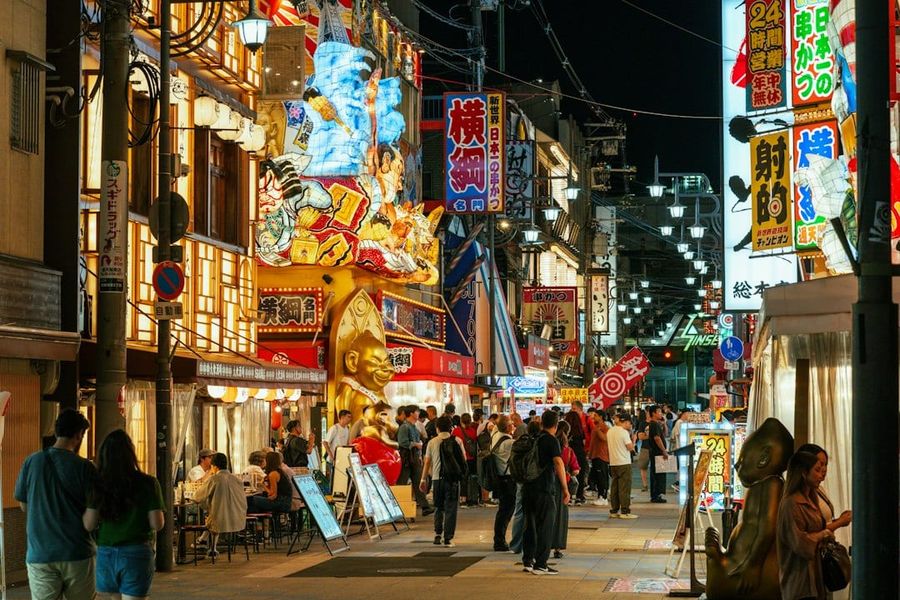
Dotonbori, Osaka — street food here is dinner and sightseeing in one budget line.
Transit and Food: The Daily Savings Engine
Trains and subways without overspending
On a Tokyo–Osaka–Seoul–Busan route, the nationwide JR Pass is worth scrutinizing rather than assuming — it's priced for extensive long-distance rail travel, and a budget route with only one Shinkansen leg may do better with point-to-point tickets plus city day passes. Check the current pass price on the official JR Pass site against your actual legs before buying; don't let a blog post from three years ago decide it.
- Tokyo: look into the tourist-oriented 24/48/72-hour subway tickets and IC cards (Suica/Pasmo) for tap-and-go convenience.
- Tokyo↔Osaka: compare the Shinkansen against highway buses — the bus trades hours for pesos, a fair deal if your schedule has slack.
- Seoul↔Busan: the KTX is the fast standard choice; our Seoul–Busan KTX booking and boarding guide covers exactly how to book and board without stress.
- Seoul: a T-money card works across subway and buses and makes transfers painless.
Eating well on a lean food envelope
Your ₱12,000 food cap works out to roughly ₱1,200 a day — comfortable if you eat like a local rather than like a tourist:
- Japan: convenience store breakfasts (onigiri, sandwiches), supermarket bento marked down in the evening, and standing noodle or gyudon shops for hot meals.
- Korea: gimbap shops, market stalls at Gwangjang-style markets, and casual kimbap/jjigae spots away from the main drag.
- One splurge meal per country, chosen deliberately — takoyaki crawl in Dotonbori, Korean BBQ in Seoul — beats five forgettable mid-range restaurant dinners.
- Carry a refillable bottle; drinks bought at every stop are a silent budget leak in both countries.
Free Sights and a Day-by-Day Allocation
A lean budget doesn't mean a thin itinerary — many of the best moments in both countries cost nothing:
- Tokyo: Senso-ji temple grounds in Asakusa, the Shibuya crossing scramble, Meiji Shrine's forest approach, people-watching in Harajuku.
- Osaka: wandering Dotonbori's neon canal strip, Osaka Castle's outer park grounds, Kuromon market browsing.
- Seoul: Bukchon Hanok Village lanes, Cheonggyecheon stream walk, Hongdae street performances, palace exteriors and changing-of-guard ceremonies viewable from outside.
- Busan: Gamcheon Culture Village's painted hillside lanes, Haeundae beach, the seaside Haedong Yonggungsa temple complex.
One popular tip worth verifying on-site: wearing hanbok is often said to earn free entry to Seoul's royal palaces. Entry policies and fees change, so check the palace's official page for current admission rules before counting on it — treat any waiver as a bonus, not a budget line.
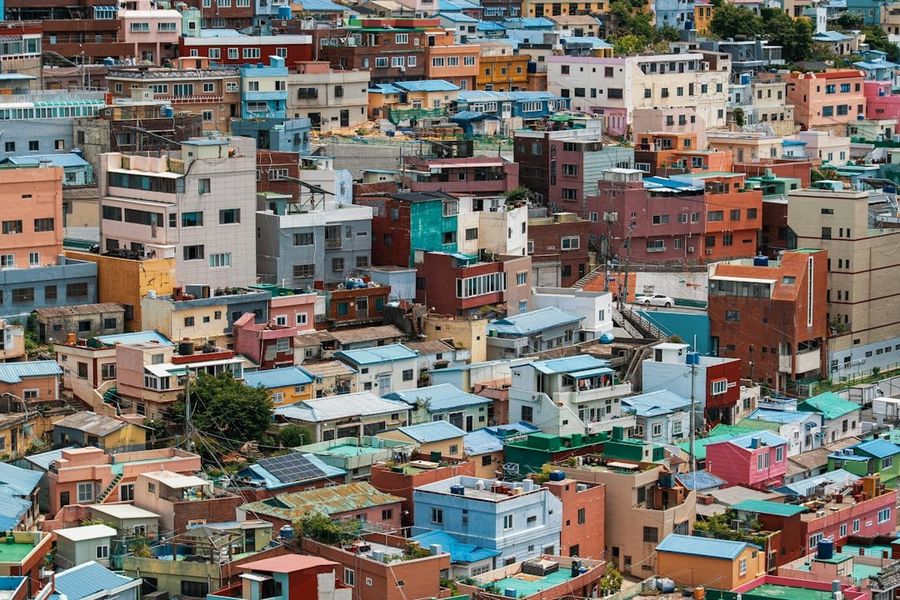
Gamcheon Culture Village, Busan — a half-day of color and views for the price of a bus fare.
Sample 10-day allocation
This routing spends 5 days in Japan and 5 in Korea, with the flight envelope front-loaded and daily spending held near ₱3,000–3,500 all-in:
| Day | Base | Focus | Daily spend target (excl. flights) |
|---|---|---|---|
| 1 | Tokyo | Arrive, Asakusa + Senso-ji | ~₱3,000 |
| 2 | Tokyo | Shibuya, Harajuku, Meiji Shrine | ~₱3,200 |
| 3 | Osaka | Train/bus west, Dotonbori evening | ~₱4,500 (intercity leg) |
| 4 | Osaka | Castle park, Kuromon, Shinsekai | ~₱3,000 |
| 5 | Seoul | Fly Osaka→Seoul, Hongdae evening | ~₱3,500 |
| 6 | Seoul | Palaces, Bukchon, Gwangjang market | ~₱3,200 |
| 7 | Busan | KTX south, Haeundae beach | ~₱4,500 (KTX leg) |
| 8 | Busan | Gamcheon, Haedong Yonggungsa | ~₱3,000 |
| 9 | Seoul | KTX back, Myeongdong, last shopping | ~₱4,500 (KTX leg) |
| 10 | Manila | Fly home | ~₱1,600 (airport transit + meals) |
Daily targets are planning guides — shift pesos between days as your actual bookings land, and keep the buffer envelope untouched until the trip is over. For a tighter first-timer version of this route, see our 7-day Tokyo + Busan itinerary; if cherry blossom season is your dream, the Japan-Korea spring itinerary shows how the same corridor works in bloom season — just expect the flight envelope to need more room.
Is ₱80,000 really enough for 10 days in Japan and Korea?
It's a workable planning ceiling for a disciplined solo traveler — early-booked open-jaw flights, hostel-type stays, local eating and mostly free attractions. It is not a guaranteed price: peak seasons and late bookings can push flights alone past the envelope, so always test the framework against live quotes for your dates.
How early should I apply for Japan and Korea visas?
Start at least one month before departure. With Mesho's visa assistance, Japan and Korea applications typically take 7–10 business days, but document gathering and appointment slots add time — especially in peak travel seasons.
Should I buy a JR Pass for this route?
Not automatically. With only one long-distance Shinkansen leg, point-to-point tickets plus city day passes may cost less. Compare the current official JR Pass price against your actual legs before deciding.
DIY or tour package — which is cheaper for two countries?
It depends on your dates. Mesho's Korea package starts from ₱45,000 (4–7 days) and Japan from ₱48,000 (5–10 days), including visa assistance, flights and ground handling. A lean DIY trip can undercut stacking both, but a well-timed package quote sometimes wins — get both numbers before committing.
Ready to make ₱80,000 happen?
Mesho builds personalized itineraries with transparent pricing and unlimited revisions before you finalize — DOT-accredited since 2017, with 24/7 travel support. Message us at info@meshotravel.com or WhatsApp +63 906 053 9130 and get your quote within 24 hours.
Request your custom quoteRelated Reading
- 7-Day Tokyo + Busan Itinerary for First-Time Filipino Travelers
- Seoul–Busan KTX: Booking and Boarding Guide for Filipinos
- Japan-Korea Spring Itinerary: Cherry Blossoms from Kyoto to Seoul
A note from Dominic Reyes — I design multi-port and cross-border itineraries at Mesho, and the two-country trips that stay on budget all share one habit: the travelers capped their categories before they fell in love with any single fare or hotel. Build your envelopes, get live quotes for both the DIY and packaged versions, and let the numbers pick your route. That's how ten days across Japan and Korea stops being a screenshot of someone else's trip and becomes yours.


