


You have just spent three days wandering the neon alleys of Myeongdong and palaces of Seoul. Now you want to feel the sea breeze along Busan's Haeundae Beach. The KTX is the obvious choice—fast, punctual, and comfortable. Yet for many Filipino travelers, the thought of navigating a Korean train station alone, reading a ticket written entirely in Hangul, and boarding the wrong car triggers real anxiety. This guide removes every layer of that uncertainty. From booking your seat online to stepping onto the Busan Metro, here is exactly what you need to do.
Booking Your KTX Ticket: Online or at the Station
Booking via the Korail Website and App
The most reliable way to secure your seat is through the official Korail channels. Visit letskorail.com or download the KorailTalk app. Both offer an English interface, though the website translation can occasionally default back to Korean during payment—so stay patient and use the language toggle in the top-right corner.
Here is the exact flow:
- Select Seoul or Seoul Station as your departure. For arrival, choose Busan. Note that some trains also depart from Yongsan Station or stop at Gwangmyeong—double-check your accommodation's proximity before confirming.
- Pick your date and preferred time. KTX trains run approximately every 15 to 30 minutes between 5:30 AM and 11:00 PM.
- Choose between Economy Class and First Class. Economy seats are arranged 2+2 across the aisle; First Class offers 2+1 seating with extra legroom and a quieter cabin.
- Enter passenger details exactly as they appear on your passport. Korail requires a passport number for reservation.
- Pay with an international credit or debit card. Visa and Mastercard are widely accepted.
After payment, you will receive a confirmation email with a reservation number. You do not need to print this. A digital copy on your phone is sufficient for boarding.
Buying at the Station
If you prefer spontaneity, purchase directly at Seoul Station. Look for the Korail ticket counters on the second floor or use the automated kiosks. The kiosks have an English option—tap the flag icon before starting.
Station purchases are ideal if your itinerary is flexible. However, during Korean public holidays such as Chuseok or Seollal, trains sell out days in advance. If your trip falls on these dates, book online at least two weeks ahead.
Payment Methods Filipinos Can Use
- International credit cards: Visa and Mastercard work on both the Korail website and station kiosks.
- Korean Won cash: Accepted at manned counters. There are currency exchange booths and ATMs inside Seoul Station if you need to withdraw.
- T-Money or WOWPASS: These transport cards cannot be used to buy KTX tickets directly. Stick to card or cash.
Decoding Your Ticket and Finding Your Way
Reading the KTX Ticket
Your ticket—whether paper or digital—displays five critical pieces of information:
- Train Number: A code like KTX 123. This identifies your specific service.
- Departure and Arrival: 서울역 (Seoul Station) to 부산역 (Busan Station).
- Date and Time: Displayed in 24-hour format. A ticket showing 09:15 means 9:15 AM.
- Car (호): The train car number, usually 1 through 16.
- Seat (석): Your exact seat number, such as 12A or 8C.
Memorize your train number and departure time. Platform screens list trains by number, not just destination, and scrolling Hangul can overwhelm first-timers.
Navigating Seoul Station
Seoul Station is enormous, but the KTX boarding area is logically arranged. After entering through the main concourse, proceed to the third floor where the KTX gates are located. Look for the overhead digital boards—they display departing trains, platforms, and real-time delays in both Korean and English.
Your platform is typically announced 15 to 20 minutes before departure. Do not panic if it is not showing when you arrive early. Use that buffer to grab a kimbap roll from a convenience store—there is a CU and 7-Eleven on the ground floor.
Car and Seat Numbering System
KTX trains have clearly marked car numbers on the exterior. Position yourself on the platform according to the platform markings—painted numbers on the ground indicate where each car will stop. If you are in Car 5, stand near the 5 marker.
Inside, seats are labeled above the headrests. Economy Class uses a 2+2 layout (A and B on the left, C and D on the right). First Class uses 2+1 (A and B on the left, C on the right solo). Window seats are A and C; aisle seats are B and D. If you want a view of the Korean countryside, request A or C when booking.
Onboard Experience: Luggage, Etiquette, and Dining
Luggage Rules and Storage
The KTX does not operate like an airline. There are no strict weight limits for personal bags, but common sense applies. Each car has overhead shelves large enough for cabin-size luggage and dedicated luggage racks at the ends of cars for larger suitcases.
A practical tip: if you are traveling with a large suitcase, board early and place it in the end-car rack. These spaces fill quickly on busy Friday evenings. If the rack is full, you may need to keep your bag in the aisle area briefly while finding a spot—just be mindful not to block the gangway.
Train Etiquette Every Filipino Should Know
Korean train culture is quiet and orderly. A few simple habits will help you blend in:
- Set your phone to silent mode. Voice calls are strongly discouraged inside the cabin.
- If you need to take a call, step into the vestibule area between cars.
- Avoid eating strong-smelling food at your seat. Light snacks are acceptable; full meals are better enjoyed in the café car.
- Recline your seat gently. Check behind you before leaning back.
Dining Car and Onboard Food
Most KTX services have a snack car offering ramyeon, hot dogs, coffee, and pre-packaged bento boxes. The quality is functional, not gourmet. If you are particular about meals, buy a lunchbox from Seoul Station's food hall before boarding.
A folding tray table is attached to the seat in front of you. It is perfectly sized for a convenience-store kimbap set and a canned latte. For a more substantial meal, time your eating before boarding—the ride is only a little over two hours.
Timetables, Fares, and What to Expect
The Seoul to Busan corridor is the busiest high-speed rail line in South Korea. Here are the practical numbers you need to plan around:
| Detail | Information |
|---|---|
| Travel Time | 2 hours 15 minutes to 2 hours 40 minutes |
| Frequency | Every 15–30 minutes, 05:30–23:00 daily |
| Economy Class Fare | ₩59,800 (approx. ₱2,500) |
| First Class Fare | ₩83,500 (approx. ₱3,500) |
| Stations Served | Seoul / Yongsan → Busan (with stops at Daejeon, Daegu, etc.) |
PHP equivalents are approximate and based on prevailing exchange rates. Always check current rates before budgeting.
Trains are rarely delayed. If you are transferring from Incheon International Airport via the AREX to Seoul Station, allow at least 90 minutes between your estimated AREX arrival and your KTX departure. The AREX takes roughly 43 minutes to Seoul Station, but immigration and luggage collection at Incheon can stretch longer than expected.
Arriving in Busan: Metro and Taxi Connections
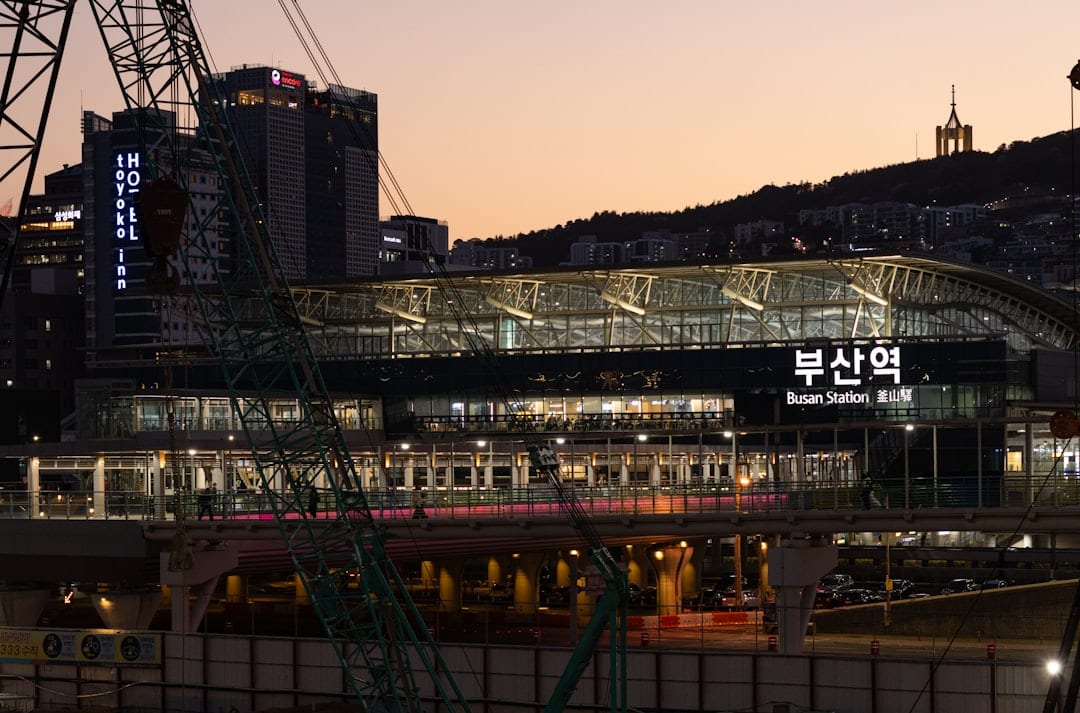
Busan Station at dusk—your gateway to the city's beaches and mountains.
Busan Station Layout
Busan Station is smaller and more manageable than Seoul Station. The KTX platforms are on the upper levels, while the exits flow down to the ground floor. Follow the signs for Busan Metro (부산지하철)—they are clearly marked in English.
Just outside the main exit, you will find a taxi stand with a queue system. Station staff often assist in directing passengers. If you are heading to Haeundae or Seomyeon, have the address written in Korean or show it on your phone map.
Metro Lines and Fares
Busan Metro Line 1 runs directly through Busan Station. This is the most useful line for travelers. Key stops include:
- Nampo Station: Gateway to Jagalchi Fish Market and the international film district.
- Seomyeon Station: Busan's commercial heart, ideal for shopping and nightlife.
- Dongnae Station: Near traditional spas and hot springs.
Metro fares start at ₩1,500 (approx. ₱65) and can be paid with a T-Money card or single-journey tickets from the station machines. If you already have a T-Money card from Seoul, it works seamlessly in Busan.
Taxi Stands and Tips
Busan taxis are color-coded by service level. Ilban (regular) taxis are silver or white and use the meter. Mobeom (deluxe) taxis are black with a gold stripe and charge a higher base fare. For most travelers, ilban taxis are perfectly adequate.
A taxi from Busan Station to Haeundae Beach costs roughly ₩15,000 to ₩20,000 (approx. ₱630–₱840) and takes about 30 minutes depending on traffic. Have your destination written in Korean—English addresses often confuse drivers outside central Seoul.
Planning your trip? Mesho Travel curates seamless Korea itineraries that include KTX reservations, hotel transfers, and guided experiences—so you never have to second-guess a platform number. Explore our Korea tour packages and let us handle the logistics.
Quick Summary: What to Remember
- Book online at letskorail.com or via the KorailTalk app for guaranteed seats, especially during Korean holidays.
- Your ticket shows train number, car, and seat—match these to platform markings and overhead labels.
- Keep luggage in overhead shelves or end-car racks; avoid blocking aisles.
- Maintain a quiet cabin—no loud calls or strong-smelling food.
- At Busan Station, connect via Metro Line 1 or the organized taxi queue to reach your hotel.
Related Reading
- Seoul Subway and T-Money Card: A Filipino First-Timer's Guide
- Busan Coastal Walk and Seafood Markets: A 2-Day Itinerary
- Seoul, Busan & Jeju: The Perfect 10-Day South Korea Itinerary
Author's Note — Grace Villareal
I have taken the KTX between Seoul and Busan more times than I can count—rushing for morning trains after late-night shoots in Myeongdong, and dozing off in First Class after packed days of temple hopping. The system is remarkably efficient once you know the rhythm. My advice? Book your seat the moment your Korea visa is approved, download the KorailTalk app before your flight, and trust the process. Korea's rail network is one of the most reliable in Northeast Asia. If you want every connection pre-arranged with local expertise, browse Mesho's Korea packages and travel with confidence.


