


There is a quiet difference between seeing autumn and experiencing it. Anyone can photograph a crimson maple tree. But to stand inside a centuries-old Zen temple as morning light filters through vermillion leaves, to hear the rhythmic sweep of a monk's broom across wet stone, to taste chestnut wagashi prepared only in the weeks between the equinox and the first frost—that is when Kyoto's autumn becomes part of you. For Filipino travelers, Japan's koyo season offers more than a visual spectacle. It is an invitation into a culture that treats seasonal transition as sacred ritual. This guide will help you navigate that invitation with grace, precision, and the kind of insider awareness that transforms a sightseeing trip into a genuine cultural immersion.
Timing the Koyo Season: When Kyoto Turns Crimson
Kyoto's autumn foliage does not arrive all at once. It descends in layers, shaped by elevation and latitude. In 2026, forecasters expect peak koyo to reach the city center between mid-November and early December, with the earliest color changes appearing in the Higashiyama mountain temples by late October.
The science behind this gradient is simple: temperatures drop roughly 0.5°C for every 100 meters of elevation. Temples perched in the hills—such as Eikan-do Zenrin-ji and Sanzen-in in Ohara—will ignite with color at least two weeks before the flat gardens of the Imperial Palace. For Filipino travelers accustomed to a single, year-round tropical palette, this staggered transformation can feel almost theatrical, as if the city were performing autumn scene by scene.
- High-elevation temples (Northern Higashiyama, Ohara, Kurama): color peaks late October to mid-November
- Central Kyoto gardens (Gion, Nijo, Imperial Palace): color peaks mid-November to late November
- Arashiyama and western districts: color peaks late November to early December
If your itinerary is flexible, plan for the second half of November. That window usually delivers the most reliable overlap between peak color and calm weather before the December chill sets in. For visa and entry logistics, begin your application by August to secure a November travel window.
Temple and Garden Etiquette: The Unspoken Rules of Autumn Visits
Kyoto's temples are not museums. They are living religious spaces, and autumn brings an intensity that demands heightened awareness. The influx of visitors strains both infrastructure and patience. Your conduct during koyo season signals whether you are a respectful guest or merely another camera in the crowd.
Photography: Know Where the Line Is
Most temples permit photography in exterior gardens, but interior halls, tatami rooms, and altars are almost universally off-limits during autumn illumination events. Look for pictogram signs at every entrance. At Tofuku-ji, tripods are banned outright. At Eikan-do, the famous maple corridor allows photos, but the staff will politely intercept anyone who blocks pedestrian flow for more than a few seconds. Flash photography is never acceptable near painted screens or lacquered altars.
Quiet Zones and Sacred Silence
Many temples designate specific garden paths as mokuseki (silent zones), particularly during early-morning opening hours. This is not a suggestion. Conversation, even whispered, carries across still water and stone. If you are traveling with family or a group, agree on a rendezvous point and split up for the first hour. The experience of walking alone through a moss garden at dawn is worth the temporary separation.
Dress Code for Cool Mornings
November mornings in Kyoto can drop to 8°C. Layering is essential, but avoid overly casual attire inside temple grounds. Sleeveless tops, short skirts, and flip-flops read as disrespectful. Comfortable walking shoes with grip are practical—temple stone steps become slick with dew and fallen leaves. A compact, dark-colored jacket photographs better against autumn backdrops and signals cultural awareness.
Five Kyoto Locations Where Autumn Reveals Itself
These five locations span the full spectrum of Kyoto's autumn character, from intimate temple corridors to sweeping bamboo groves. Each offers a distinct emotional register, and together they form a curated arc through the season.
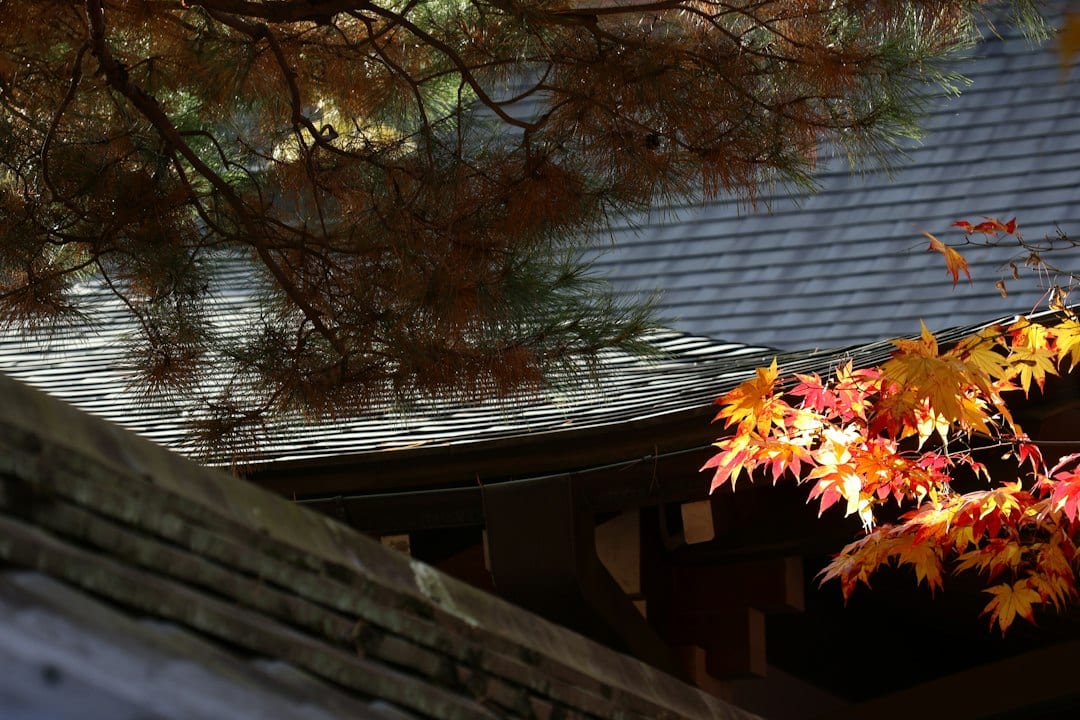
A Kyoto temple garden at the height of the koyo season
1. Eikan-do Zenrin-ji (Northern Higashiyama)
This is the temple that locals recommend first. Eikan-do is famous for its momiji corridor, a covered walkway that frames hundreds of maple trees against the temple pond. The reflection at dusk, when the garden is illuminated, is one of Kyoto's most meditative sights.
Transit: Take the Eizan Railway from Demachiyanagi Station to Ichijoji Station, then walk 10 minutes. Alternatively, city buses 5 or 17 from Kyoto Station take roughly 35 minutes. Arrive before 8:00 AM to experience the garden in near-solitude.
2. Tofuku-ji (Southern Higashiyama)
Tofuku-ji's Tsutenkyo Bridge spans a valley of maples so dense that the canopy forms a tunnel of fire. The sheer scale is overwhelming in the best way. This is also one of the busiest temples during peak season, so timing is everything.
Transit: A direct ride on the JR Nara Line from Kyoto Station to Tofukuji Station takes 3 minutes. From there, it is a 10-minute walk. The temple opens at 8:30 AM; aim to be in line by 8:15 AM.
3. Arashiyama (Western Kyoto)
Arashiyama is not a single temple but a district, and that is its strength. The Tenryu-ji Temple garden—a UNESCO World Heritage Site—opens onto the iconic bamboo grove. In late November, the grove's cool green verticality contrasts with the fiery maples of the temple grounds. The Togetsukyo Bridge over the Katsura River offers a classic panorama.
Transit: Take the JR Sagano Line from Kyoto Station to Saga-Arashiyama Station (15 minutes), or the Keifuku Randen tram for a more scenic approach through residential streets. The tram is slower but far more atmospheric.
4. Kiyomizu-dera (Eastern Higashiyama)
The wooden stage of Kiyomizu-dera juts over a hillside that becomes an ocean of red and orange each November. The view from the stage is justifiably famous, but the lesser-known Jishu Shrine and Okunoin Hall behind the main hall offer quieter corners with equally rich foliage.
Transit: Bus 100 or 206 from Kyoto Station to Kiyomizu-michi or Gojo-zaka, followed by a 10-minute uphill walk. The approach through Ninenzaka and Sannenzaka preserves streets is particularly beautiful at dawn when the stone paths are empty.
5. Ryoan-ji and Kinkaku-ji (Northwestern Kyoto)
These two World Heritage Sites sit within walking distance of each other. Kinkaku-ji (the Golden Pavilion) is iconic year-round, but the mirror pond reflecting both gold leaf and autumn sky is singular. Nearby Ryoan-ji offers the famous rock garden, where fallen maple leaves occasionally drift onto the raked white gravel—a fleeting, unscripted composition that changes by the hour. Transit: City bus 205 from Kyoto Station to Kinkakuji-michi (40 minutes).
Seasonal Food Culture: Eating the Autumn Landscape
Kyoto's culinary calendar moves in sync with the mountains. Autumn is not merely a backdrop for meals; it is an ingredient. The kaiseki tradition, which structures multi-course dining around seasonal transition, reaches its most expressive form during October and November.
Kaiseki Elements to Request
A proper autumn kaiseki will include matsutake mushroom (pine mushroom) in clear dashi, sanma (Pacific saury) grilled with salt, and yuba (tofu skin) preparations that reference the pale gold of late-season ginkgo leaves. The final rice course often arrives with kuri gohan—chestnut rice—whose sweetness mirrors the day's visual palette.
Street Snacks Along the Temple Routes
Between temples, look for small stalls selling yaki-imo (roasted sweet potato) wrapped in newspaper, and momiji tempura—maple leaves preserved in salt, battered, and fried into crisp, edible souvenirs. In Arashiyama, the tofu ice cream stands offer a surprisingly creamy palate cleanser after hours of walking.
Tea Ceremony Timing
Autumn tea ceremonies in Kyoto often feature nodate—outdoor sessions in temple gardens. The Camellia Flower Teahouse near Kiyomizu-dera and En Tea House in Gion both offer abbreviated sessions for foreign visitors. These are not tourist performances; they are structured opportunities to pause. The wagashi served will likely be chestnut-based, shaped like a fallen leaf or a full moon. Book at least three days ahead during koyo season.
Crowd Navigation and Early-Morning Routing
Kyoto receives millions of autumn visitors annually. For Filipino travelers making a once-in-a-lifetime journey, the difference between a transcendent morning and a claustrophobic afternoon often comes down to a single hour.
| Time | Strategy | Best For |
|---|---|---|
| 6:30 – 8:30 AM | Arrive at first temple before opening; photograph in soft light | Eikan-do, Tofuku-ji |
| 8:30 – 11:00 AM | Move to second location as first crowds arrive | Kiyomizu-dera, Ryoan-ji |
| 11:00 AM – 2:00 PM | Lunch and indoor tea ceremony; avoid major temples | Gion, Pontocho alley |
| 2:00 – 4:30 PM | Resume temple visits as morning tour groups depart | Arashiyama, Kinkaku-ji |
| 5:00 – 7:00 PM | Evening illuminations; book timed-entry tickets in advance | Eikan-do, Kiyomizu-dera |
A practical routing for a two-day autumn visit might look like this: Day One begins at Eikan-do at 7:30 AM, moves to Tofuku-ji by 10:00 AM, and concludes with an afternoon tea ceremony in Gion. Day Two starts at Kiyomizu-dera at 7:00 AM, descends through Ninenzaka for a late breakfast, then heads to Arashiyama after lunch for the bamboo grove and Tenryu-ji at 3:00 PM.
For transport between these districts, the JR Pass covers the Nara and Sagano Lines, but city buses require exact change or an IC card (ICOCA or Suica). Load ¥2,000 (approximately PHP 800) onto a card at Kyoto Station and tap in and out. If you are unsure whether the JR Pass fits your broader itinerary, our cost breakdown guide breaks down the math in Philippine pesos.
Planning Your Autumn Journey?
Mesho's curated Japan autumn tours include priority temple access, bilingual guides familiar with koyo timing, and carefully routed itineraries that place you at the right garden at the right hour. Let us handle the logistics so you can focus on the experience.
Explore Japan Autumn ToursThe Cultural Layer: What Autumn Means in Kyoto
To understand why Kyoto's autumn feels different from any other destination, it helps to know the concept of mono no aware—the pathos of things, or the bittersweet awareness of impermanence. Japanese aesthetics do not treat falling leaves as decay. They treat them as visible proof that beauty is inseparable from its ending.
"The maple leaf does not resist the wind. It turns, it falls, and in that surrender, it becomes more beautiful than when it clung to the branch."
— A perspective shared by a Kyoto garden caretaker during the 2024 koyo season
This philosophy explains the meticulous care given to autumn gardens. Monks do not sweep away every fallen leaf. They leave a measured scattering on stone paths and moss, composing a landscape that changes by the hour. When you visit, you are not interrupting a static scene. You are stepping into a conversation between wind, water, wood, and time.
For Filipino travelers, this sensibility may feel familiar. The Filipino concept of pasasaan ba't hindi magwawakas—all things must pass—resonates with mono no aware. Both cultures find meaning in the temporary. Recognizing that parallel can deepen your presence in Kyoto's temples. You are not just observing a foreign custom. You are recognizing a shared human language spoken through leaves.
Ready to Experience Kyoto's Autumn?
Autumn in Kyoto rewards the prepared traveler. The colors are unforgettable, but the memories that stay with you longest—the hush of a moss garden at dawn, the steam rising from a bowl of chestnut rice, the monk's broom scraping stone—belong to those who arrive with patience, respect, and a little insider knowledge.
Let Mesho curate your autumn journey to Kyoto. From visa assistance and JR Pass coordination to timed temple entries and English-speaking guides who understand both Japanese etiquette and Filipino travel needs, we build itineraries that move at the pace of the season—not the pace of the crowd.
Quick Summary: Kyoto Autumn Essentials
- Best timing: Mid-November to early December for central Kyoto; late October for high-elevation temples
- Etiquette priority: No flash photography indoors, observe silent zones, dress modestly with grippy shoes
- Top five locations: Eikan-do, Tofuku-ji, Arashiyama, Kiyomizu-dera, and Kinkaku-ji/Ryoan-ji
- Seasonal must-tries: Autumn kaiseki with matsutake, chestnut wagashi, and outdoor tea ceremony
- Crowd strategy: Arrive at opening (7:30–8:30 AM), plan indoor activities during midday peak, book illumination tickets in advance
Related Reading
- Japan in Autumn: A Cultural Guide to Festivals, Foliage, and Traditions A nationwide overview of koyo season, regional festivals, and autumn customs beyond Kyoto.
- Japan 8-Day Itinerary: Tokyo, Kyoto, and Osaka for First-Time Filipino Travelers A complete route with JR Pass calculations, budgets in PHP, and day-by-day logistics.
- Japan Visa Requirements for Philippine Passport Holders in 2026 Documents, processing timelines, fees in PHP, and tips for a smooth application.
About the Author: Grace Villareal is Mesho's Northeast Asia travel editor, based in Taipei with years of experience covering border details, etiquette, and seasonal traditions across Japan, Korea, Taiwan, and Greater China. She believes the best travel moments happen when logistics fade into the background and cultural presence takes over.


