


You have eight hours in Bali. The ship's gangway drops at Benoa Harbor, and the humid air hits you with the scent of frangipani and diesel. Most passengers will head straight for the beach clubs of Seminyak or the resort gates of Nusa Dua. But you want something else: the Bali of layered gamelan music, of hands moving across silver with practiced precision, of temple courtyards where stone guardians watch over centuries of ritual.
Ubud sits roughly 40 kilometers northeast of the harbor. In a single morning, you can move through three distinct art villages, witness artisans at work, and stand inside a water temple where purification rites continue unchanged. The challenge is not desire; it is time. A cruise port day demands discipline, but it does not demand compromise.
This guide maps a culturally rich, logistically sound route from Benoa Harbor to Ubud and back. You will learn how to choose between a cruise-line excursion and an independent driver, how to visit Batuan, Celuk, and Mas with genuine respect, and how to navigate temple etiquette that keeps you welcomed rather than merely tolerated. Most importantly, you will learn how to return to ship with time to spare.
Getting from Benoa Harbor to Ubud: Route & Transport Choices
The journey from Benoa Harbor to Ubud covers roughly 35–45 kilometers through Gianyar Regency. Morning traffic typically moves well; the return is where plans unravel. Expect 60–75 minutes outbound if you leave by 08:00, and up to 90 minutes coming back during afternoon congestion. Your first decision is how you get there.
Cruise Excursion vs. Private Driver
Both options have merit. The right choice depends on your risk tolerance and how deeply you want to engage.
| Factor | Cruise Excursion | Private Driver |
|---|---|---|
| Group Size | 30–40 passengers | Just your party |
| Itinerary Control | Fixed schedule | Fully customizable |
| Cost Estimate | PHP 8,000–12,000 per person | PHP 3,500–5,000 total + fuel |
| Ship Return Guarantee | Yes (ship waits or refunds) | Self-managed risk |
| Artisan Interaction | Brief, group-oriented | Direct, personal |
| Flexibility | None | High |
If you are comfortable managing your own timeline, a private driver offers deeper cultural access and significant savings. You control how long you linger in a silver workshop or whether you skip a crowded stop entirely. If you prefer zero risk, the ship's excursion provides peace of mind, though the experience tends toward the surface level. Either way, depart Benoa by 08:00 to maximize your morning.
The Art Villages: What to See in Batuan, Celuk, and Mas
The road from Denpasar to Ubud threads through a sequence of villages where craft is not tourism decoration—it is livelihood and lineage. You do not need to visit every studio. Choose two or three stops, engage fully, and resist the urge to collect snapshots instead of understanding.
Batuan (Painting)
Batuan has produced master painters since the 1930s. The style here is dense, intricate, and traditionally narrative—scenes from the Ramayana, daily village life, and Balinese Hindu cosmology rendered in natural pigments on cloth. Studios line the main road; many welcome visitors directly into workspaces where artists apply layer after layer of detail with brushes made from squirrel hair or bamboo.
Visiting tip: Ask before photographing an unfinished work. Some pigment mixtures are proprietary family recipes, and artists may prefer not to document them. Purchases directly from studios typically cost 30–50% less than gallery equivalents in Ubud town center.
Celuk (Silver)
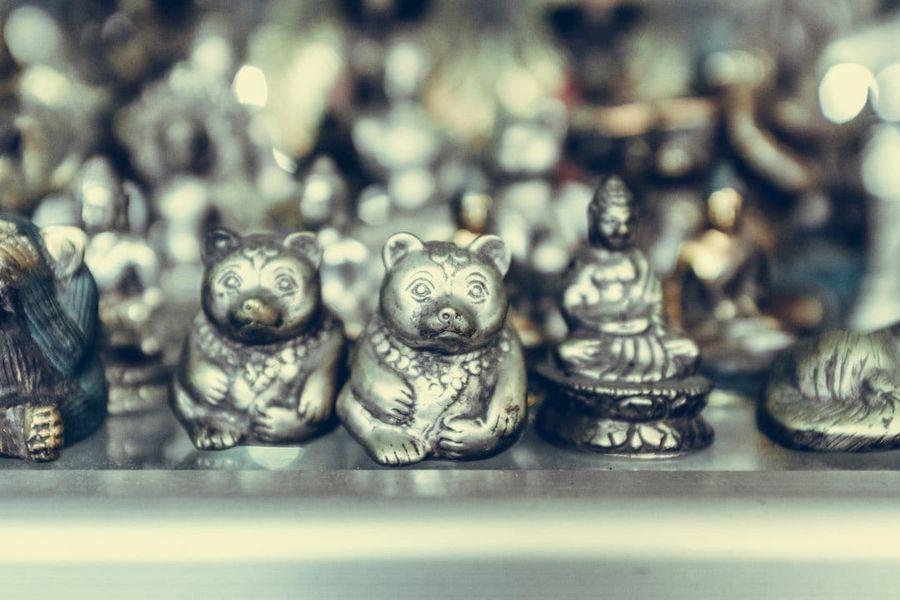
Celuk silver workshop where artisans craft traditional Balinese filigree jewelry
Celuk's smiths specialize in filigree and granulation—techniques requiring months of training to execute cleanly. You will find everything from delicate earrings to ceremonial bowls. The best workshops demonstrate technique openly, letting you watch solder flow under a jeweler's torch while an apprentice hammers sheet metal into shape.
Visiting tip: Quality varies. Look for stamps indicating silver purity (usually 925). Bargaining is expected, but do so respectfully—start at roughly 70% of the quoted price and meet near the middle. If a piece speaks to you, buying directly from the maker ensures your money supports the craft, not just a reseller.
Mas (Wood Carving)
Mas is the center of Balinese wood carving, particularly the traditional patung figures and intricate relief panels destined for temples and private villas. The scale ranges from palm-sized deities to monumental doors that take months to complete. Walking through a Mas workshop means navigating piles of jackfruit wood, sandalwood, and suar while carvers work with mallets and chisels, the rhythmic tapping audible from the street.
Visiting tip: Large pieces can be shipped internationally, but for a port day, focus on smaller, portable items. Many workshops will wrap carvings securely for airline travel if you mention you are cruising and need protection for the journey home.
Temple Etiquette for Ubud's Sacred Spaces
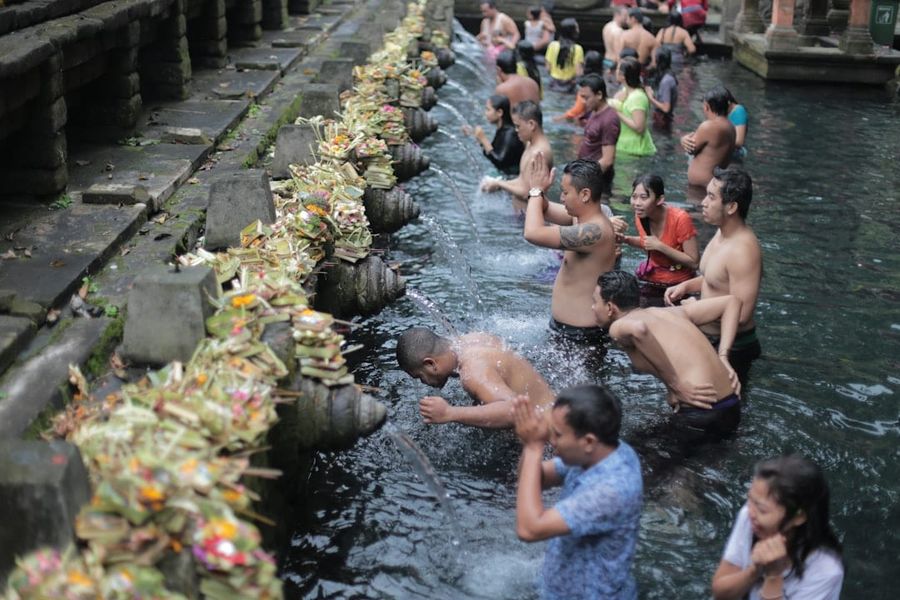
Water temple purification pools at Tirta Empul near Ubud
Temples in Ubud fall into two categories you are likely to encounter: active water temples (pura) and royal palace grounds (puri). Both require preparation, and both reward visitors who enter with genuine humility.
Tirta Empul is the most visited water temple near Ubud. Devotees and visitors alike enter the purification pools. Participation is welcomed, but only if you follow the ritual structure: offer a small donation, receive a blessing from a priest, enter the pools from the leftmost spout, and move systematically right. Do not skip spouts, splash casually, or treat the water as a swimming pool.
Puri Saren Agung (Ubud Royal Palace) and Pura Taman Saraswati (the Water Lotus Temple) are more accessible but no less sacred. At both sites, observe the following:
- Wear a sarong and sash. Most temples rent or lend them at the entrance for a small donation (IDR 20,000–50,000). Carry your own if possible to save time.
- Cover shoulders and knees. This applies to all genders without exception.
- Never position yourself higher than a priest during an active ceremony. If a ritual is in progress, remain at the outer courtyard unless explicitly invited forward.
- Avoid pointing the soles of your feet toward altars or seated elders. Sit side-saddle or kneel when resting near sacred structures.
- Photography rules: Generally permitted in outer courtyards. Ask before shooting inside inner sanctums. Flash is prohibited everywhere.
A note for Filipino Catholics: the respectful posture will feel familiar. The act of covering limbs, the quiet reverence in sacred space, and the physical ritual of water all echo practices at home. Lean into that familiarity rather than distance.
For a broader primer on temple behavior across Bali, see our guide on Bali Temple Etiquette for Filipino Travelers.
Timing Your Return: The Ship Won't Wait
This is the section that separates a memorable day from a cautionary tale. Cruise ships operate on maritime time, and all-aboard is non-negotiable.
- Depart Benoa by 08:00 to reach Ubud by 09:15–09:30 with traffic accounted for.
- Leave Ubud by 14:00 at the latest for a 16:00–17:00 all-aboard time. This gives you a 90-minute buffer even if southern Bali congestion thickens.
- Friday afternoons and Hindu festival days can add 30–45 minutes to the return. Check the Balinese temple calendar (Odalan) before your sailing.
- Set two alarms: one for 13:30 (wrap-up) and one for 13:45 (departure). Do not rely on memory after a morning of sensory immersion.
If booking a private driver, confirm explicitly that they understand cruise ship deadlines. A reputable driver will not need reminding, but verbal confirmation prevents miscommunication. Keep the ship's port agent number saved in your phone as a fallback.
Planning your Oceania Bali–Hong Kong sailing? Mesho Travel curates pre-arranged private drivers and culturally guided shore excursions that align precisely with your ship's timeline. See the full itinerary on our Oceania 14-Day Bali–Hong Kong Cruise page.
What to Carry: Cash, Clothing & Cultural Courtesy
Cash & Currency
Indonesia remains heavily cash-based in artisan villages. Carry Indonesian Rupiah (IDR) in small denominations—10,000, 20,000, and 50,000 notes. Few village workshops accept cards, and ATM availability in Mas and Batuan is limited. As of late 2026, PHP 1 converts to roughly IDR 270–280, so a modest PHP 2,000 budget becomes approximately IDR 540,000–560,000. That is sufficient for modest purchases, temple donations, driver tips, and a simple lunch.
Clothing & Footwear
Wear lightweight, breathable fabrics with covered shoulders and knees. A sarong doubles as temple attire and sun protection. Choose comfortable walking shoes with good grip—temple courtyards can be mossy and uneven, and workshop floors are often scattered with wood shavings or stone dust. Bring a reusable water bottle; Bali's heat is unforgiving, and dehydration sneaks up quickly.
Supporting Artisans Directly
The villages around Ubud depend on direct patronage. Here is how to ensure your visit benefits the people doing the work:
- Buy from the workshop, not the airport. Airport gift shops mark up identical pieces by 200% or more, and the markup rarely reaches the original maker.
- Ask about technique. Artisans in these villages often speak enough English to explain their process. The question signals respect and transforms a transaction into an exchange.
- Avoid aggressive bargaining. A few thousand rupiah mean little to a cruise passenger but matter significantly to a maker supporting an extended family.
Quick Summary: Your Ubud Port Day at a Glance
- Depart early: Leave Benoa Harbor by 08:00 to beat traffic and maximize your morning in the art villages.
- Choose your transport wisely: Private drivers offer depth and savings; cruise excursions offer guaranteed returns.
- Visit with respect: Ask before photographing artisans, dress modestly for temples, and observe ritual boundaries at water temples like Tirta Empul.
- Carry cash in small bills: Village workshops rarely accept cards; small IDR notes make purchasing and tipping seamless.
- Return by 14:00: Build a 90-minute buffer into your journey back to Benoa. The ship will not wait.
Related Reading
- Bali Temple Etiquette: What Filipino Travelers Should Know Before Visiting
- What to Pack for a 14-Day Southeast Asia Cruise: A Filipino Traveler's Checklist
- Oceania 14-Day Bali–Hong Kong Cruise Itinerary & Shore Excursion Details
Author's Note: Dominic Reyes is a cruise and multi-port itinerary specialist with deep knowledge of Southeast Asian departure routes from Manila, Hong Kong, and Singapore. He designs shore excursions that balance cultural depth with ship-time discipline, ensuring you return to the gangway with stories worth repeating.
Ready to experience Ubud's living culture? Let Mesho curate your journey.


