


You are standing at the edge of Pit 1, and the silence is heavier than the earth itself. Row upon row of clay soldiers—each face distinct, each armor fold intentional—stares back across 2,200 years. Somewhere behind you, a tour guide whispers in Mandarin. Your camera feels unnecessary. This is not a museum piece behind glass. This is an army waiting underground, and for a moment, you believe they might breathe.
Xi'an is not Beijing's polished grandeur or Shanghai's neon velocity. It is China's marrow—the starting point of the Silk Road, the seat of thirteen dynasties, and home to two extraordinary experiences that sit unexpectedly close together: the subterranean stillness of the Terracotta Army and the aromatic, living chaos of the Hui Muslim Quarter. For Filipino travelers with a Philippine passport and a valid Chinese visa, this pairing delivers one of the most immersive single-day journeys in East Asia. This guide balances the poetry of the past with the exact buses, metro lines, and skewers you will need to navigate it.
The Eighth Wonder: Why the Terracotta Army Still Commands Awe
In 1974, farmers digging a well outside Xi'an uncovered what would become one of the most significant archaeological finds in human history: the burial complex of Qin Shi Huang, China's first emperor. The Terracotta Army—an estimated 8,000 soldiers, 130 chariots, and 670 horses—was never meant to be seen. It was built to guard the emperor in the afterlife, an entire military force molded in terracotta and buried in formation.
What separates this site from other ancient monuments is scale combined with individuality. No two faces are identical. Armor patterns denote rank. Hairstyles signal military units. The craftsmanship suggests an imperial workshop that operated like a modern assembly line—molds for torsos, hand-sculpted heads, mineral-based pigments that once colored every uniform. Though much of that paint flaked away within minutes of exposure to air, the restoration teams continue to piece together soldiers in climate-controlled labs visible to visitors.
For Filipinos raised on Spanish-colonial churches and bamboo heritage, the Qin Dynasty aesthetic feels alien in the best way. There are no soaring domes here—only earthen roofs, sunken corridors, and the overwhelming patience of clay. It is a reminder that civilization's great expressions take radically different forms across cultures.
Getting There: Metro Lines, Bus Numbers, and Exact Routes
The Terracotta Warriors lie roughly 40 kilometers east of Xi'an's city center in Lintong District. Three transport options work reliably for independent travelers. Taxis and DiDi rides cost roughly ¥150–200 one-way (about ₱1,200–1,600), but public transit is straightforward and far cheaper.
Option 1: Metro Line 9 + Bus 602/613 (Most Reliable)
- Board Metro Line 9 from anywhere in Xi'an and ride to Huaqingchi Station (华清池站), the northeastern terminus. The journey from downtown takes roughly 50–60 minutes.
- Exit the station and walk to the nearby bus terminal. Take bus 602 or 613 (¥2–3, roughly ₱16–24) directly to the Terracotta Warriors parking area. The bus ride is about 15 minutes.
- Total cost: under ¥15 (about ₱120) one-way. Total time: approximately 90 minutes from central Xi'an.
Option 2: Tourism Bus Line 5 (Bus 306) from Xi'an Railway Station
- From Xi'an Railway Station (西安火车站), board the green Tourism Bus Line 5, also labeled bus 306. This is a dedicated tourist coach, not a city bus.
- The ride takes 60–70 minutes and costs ¥7 (about ₱56). It terminates directly at the Terracotta Warriors site.
- Be cautious of touts in the station plaza wearing fake uniforms. The real bus departs from the official east parking lot, not from random individuals approaching you.
Option 3: Metro Line 1/9 to Fangzhicheng + Direct Bus
- Take Metro Line 1 or Line 9 to Fangzhicheng Station (纺织城站).
- Transfer to the direct tourist bus to the Terracotta Warriors. This route is slightly faster if you are staying on the eastern side of Xi'an.
The site opens at 8:30 AM. If you leave central Xi'an by 7:00 AM, you will arrive at the opening rush and enjoy cooler temperatures and thinner crowds. The entrance fee is ¥120 (approximately ₱960) during peak season and ¥60 (approximately ₱480) during low season.
Navigating the Three Pits: Where to Look First
The excavation site is larger than most first-time visitors expect. You will pass through security, then walk across landscaped grounds before reaching the main exhibition halls. The complex includes three primary pits, a museum building, and a cinema showing a 360-degree film. Here is how to sequence your visit.
Pit 1: The Main Army Formation
This is the postcard moment. Pit 1 houses roughly 6,000 infantry and chariot warriors arranged in battle formation inside a hangar-sized structure. Walk the perimeter walkway counterclockwise to view the front ranks, then pause at the rear where restoration teams work at long tables under fluorescent lights. Watching archaeologists reattach a clay ear or position a torso gives you a visceral sense of ongoing discovery.
Pit 2: The Special Forces
Pit 2 is smaller but denser with variety. This is where you find the famous kneeling archer, the standing archer, and a bronze chariot team. The pit remains largely unexcavated to preserve painted details, so you look down onto a grid of timber beams and compressed earth. The glass display cases along the perimeter hold individual figures removed for conservation—examine the sole patterns on the boots and the threading on the armor.
Pit 3: The Command Center
The smallest pit, shaped like a concave character, is believed to be the army's command post. High-ranking officers and a war chariot were positioned here. It takes only ten minutes to circle, but the intimacy is striking—you are close enough to see the expression on a general's face.
The Museum and Cinema
Do not skip the Bronze Chariots Exhibition Hall. The two half-scale bronze chariots—each drawn by four horses and driven by a standing figure—are the most finely crafted objects in the entire complex. Cast in bronze with gold and silver inlay, they demonstrate Qin Dynasty metalworking that rivals anything in Europe at the time. The 360-degree cinema (¥30 extra, about ₱240) is skippable if you are pressed for time, but offers decent historical context.
"Arrive at 8:30 AM and go straight to Pit 1. By 10:00 AM, the tour buses from downtown arrive and the walkways become shoulder-to-shoulder. If you visit in reverse—museum first, then Pit 3, 2, and 1—you may find Pit 1 slightly emptier by late morning."
Evening in the Muslim Quarter: A Living Food Culture
When the sun sets over Xi'an's drum tower, the Hui Muslim Quarter transforms. What was a quiet alley of dried-fruit vendors becomes a river of smoke, sizzling oil, and cumin. The Hui people—Chinese-speaking Muslims descended from Silk Road traders, merchants, and soldiers—have inhabited this neighborhood for over a thousand years. Their food is not Middle Eastern; it is distinctly Xi'anese, shaped by halal rules and Central Asian spice routes.
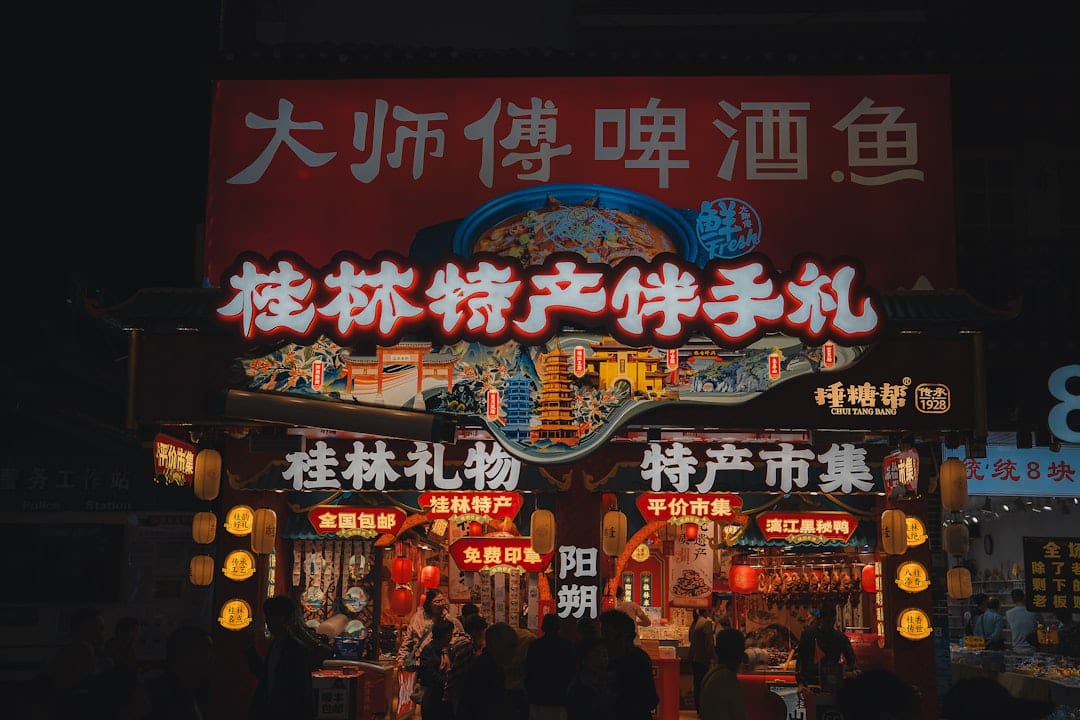
The Muslim Quarter's Beiyuanmen Street at dusk, where charcoal grills and lamb skewer smoke fill the air.
What to Eat: A Street-by-Street Guide
Start at Beiyuanmen Street (北院门), the main pedestrian artery running north from the Drum Tower. Then branch into the smaller lanes—Xiyangshi (西羊市) and Damaishi (大皮院)—where prices drop and flavors deepen.
- Roujiamo (肉夹馍): Often called the world's oldest hamburger. Slow-braised lamb or beef is stuffed into a crisp, hearth-baked flatbread. Look for vendors using iron drums as ovens. A good one costs ¥8–15 (about ₱64–120).
- Yangrou Paomo (羊肉泡馍): A hearty lamb stew served with hand-torn pieces of unleavened bread. You sit and tear the bread yourself into pea-sized chunks before the kitchen simmers it into the broth. It is a commitment—plan twenty minutes of tearing—but the reward is a bowl of aromatic, cardamom-scented comfort. Expect ¥25–40 (about ₱200–320).
- Biangbiang Noodles (Biángbiáng面): Named after the sound of dough slapping the counter, these belt-wide noodles are hand-pulled, boiled, and dressed with chili oil, vinegar, and minced garlic. One bowl is a meal. Price: ¥12–20 (about ₱96–160).
- Cumin Lamb Skewers (羊肉串): Grilled over charcoal on willow branches, heavily dusted with cumin, chili, and salt. Order five at a time from any stall with a visible coal bed. Five skewers cost roughly ¥20 (about ₱160).
- Qinzhen Liangpi (秦镇凉皮): Cold wheat or rice starch noodles bathed in chili oil, vinegar, and sesame paste. Refreshing during humid Xi'an summers. Price: ¥6–10 (about ₱48–80).
- Tanghulu (糖葫芦): Skewered hawthorn berries or strawberries coated in hardened sugar syrup. The sweet-sour crunch is addictive and costs ¥5–10 (about ₱40–80).
If you need a break from the crowd, step into the Great Mosque of Xi'an, tucked quietly behind Beiyuanmen. Unlike mosques with domes and minarets, this one follows classical Chinese courtyard architecture—timber halls, moon gates, and incense burners—reflecting the deep synthesis of Hui and Han cultures. Entry is ¥25 (about ₱200) and modest dress is required.
Itinerary Options: Half-Day vs. Full-Day Timing
Your available time and energy level should determine your approach. Both itineraries assume you are staying in central Xi'an, near the Bell Tower or Muslim Quarter.
The Focused Half-Day: Warriors Only
| Time | Activity |
|---|---|
| 07:00 | Breakfast near your hotel; board Metro Line 9 toward Huaqingchi. |
| 08:30 | Arrive at Terracotta Warriors; purchase ticket and enter. |
| 08:45–10:30 | Pit 1 (main formation), then Pit 2 and Pit 3. |
| 10:30–11:15 | Bronze Chariots Museum. |
| 11:15–12:30 | Return to Xi'an city center; light lunch near Bell Tower. |
| Afternoon | Free for city wall cycling, Big Wild Goose Pagoda, or rest. |
The Full Cultural Day: Warriors + Muslim Quarter
| Time | Activity |
|---|---|
| 07:00 | Depart central Xi'an via Metro Line 9 + bus 602/613. |
| 08:30–12:00 | Full site visit: Pits 1, 2, 3, and Bronze Chariots Museum. |
| 12:00–13:30 | Return transit; lunch near hotel or quick rest. |
| 14:00–17:00 | Optional afternoon: Xi'an City Wall walk or Shaanxi History Museum. |
| 17:30–19:30 | Early dinner or rest; freshen up at hotel. |
| 19:30–22:00 | Muslim Quarter food walk: Beiyuanmen → Xiyangshi → Damaishi. |
| 22:00 | Nightcap of pomegranate juice or sweet osmanthus wine near Drum Tower. |
The full-day itinerary demands stamina, but it rewards you with a complete arc: the solemnity of ancient empire in the morning, the vitality of living tradition at night. For travelers on a tighter schedule, the half-day warriors-only route still delivers the headline experience without exhaustion.
Practical Notes for Filipino Travelers
- Visa: Philippine passport holders require a Chinese tourist visa (L visa) before departure. Apply at the Chinese Embassy in Manila or through an accredited travel agency like Mesho. Processing typically takes 4–7 working days.
- Currency: China is largely cashless for locals, but foreign cards often fail on WeChat Pay or Alipay without a mainland bank account. Bring sufficient Chinese Yuan (CNY/RMB) in cash. ATMs at major banks (ICBC, Bank of China) accept Philippine-issued Visa and Mastercard. As of 2026, ¥1 ≈ ₱8.
- Language: English signage is limited outside international hotels. Download Pleco (Chinese dictionary) and offline maps before you leave Philippine Wi-Fi.
- Weather: Xi'an summers (June–August) are brutally hot and dry. Spring (April–May) and autumn (September–October) offer the most pleasant temperatures for walking the pits and the quarter.
- Etiquette: Do not touch the warriors or lean over railings for photos. Flash photography is prohibited in the museum hall housing the bronze chariots.
Planning your trip? Mesho's China Tour Packages & Travel Guide covers visa assistance, curated itineraries, and guided options that remove the guesswork from metro transfers and ticketing.
Quick Takeaways
- ▸ The Terracotta Army is 40km east of Xi'an; Metro Line 9 to Huaqingchi + bus 602/613 is the most reliable public route.
- ▸ Arrive at 8:30 AM to experience Pit 1 before the tour-bus crowds arrive at 10:00 AM.
- ▸ Budget ¥120 (≈₱960) for the warriors' entrance and at least ¥50 (≈₱400) for a satisfying food walk in the Muslim Quarter.
- ▸ Do not miss the Bronze Chariots Exhibition Hall or the hand-torn bread ritual of yangrou paomo.
- ▸ Spring and autumn offer the best weather for combining outdoor archaeology with evening street food.
Related Reading
- Hong Kong & Macau in 4 Days: Perfect Itinerary for Filipino Travelers
- Hong Kong and Macau Etiquette: Essential Customs for Filipino Travelers
- Octopus Card and Hong Kong Transport: A Filipino First-Timer's Complete Guide
Ready to Walk Among Empires?
Xi'an demands more than a rushed photo at the pits. It asks you to tear bread into a bowl of lamb soup at midnight. To watch an archaeologist reattach a soldier's arm. To understand that China's history is not a single narrative but a convergence of Silk Road traders, imperial ambition, and halal kitchens that have fed travelers for a millennium.
Ready to experience Xi'an? Let Mesho curate your journey through ancient China with guided day trips, visa support, and handpicked accommodations that put the Drum Tower within walking distance of your dinner plans.
Author's Note — Grace Villareal
Based in Taipei and covering Northeast Asia for over a decade, I have crossed the Qinling Mountains into Xi'an in every season. The warriors do not change, but the light on their faces does. My advice: go on a Tuesday in late October, when the morning fog lingers over Pit 1 and the Muslim Quarter's lamb skewer vendors are just lighting their grills. If you have questions about cross-border connections from Xi'an to other Chinese cities—or onward to Taiwan, Japan, or Korea—our team at Mesho is happy to map the route.


