


You have already walked the palaces of Seoul, hunted for skincare in Myeongdong, and maybe even sang your heart out in a Hongdae noraebang. But somewhere between the third subway transfer and the fourth cafe queue, a quiet question surfaces: Is this all there is to South Korea? For many Filipino travelers, the answer sits 325 kilometers southeast, where the mountains collapse into the sea and the pace slows from metropolis to maritime rhythm. That place is Busan.
Korea's second-largest city rewards the curious with cliffside temples, working seafood markets, and hillside villages painted in impossible colors. This itinerary is built for travelers arriving by KTX from Seoul or cruise ship at Busan Port, designed to compress the city's best coastal and cultural moments into exactly 48 hours. You will leave with salt on your lips, camera rolls full of hanok murals, and a firm answer to why Busan deserves its own chapter in your Korea story.
Getting to Busan from Seoul
Before the temples and the seafood, you need to close the distance. Most Filipino travelers enter Korea through Incheon International Airport and spend their first days in Seoul. Extending south is straightforward, but the method you choose shapes your budget and your schedule.
KTX: The Most Seamless Option
The Korea Train eXpress (KTX) runs from Seoul Station to Busan Station in roughly 2 hours and 15 minutes. Trains depart every 20–30 minutes from early morning until late evening. A standard-class ticket costs approximately 59,800 KRW (about 2,500 PHP), while first-class runs closer to 83,000 KRW (~3,500 PHP).
Booking tips:
- Reserve through the KorailTalk app or website at least 3–5 days ahead during spring (cherry blossom season) and autumn (foliage season), when weekend seats sell out fast.
- Philippine-issued credit cards usually work on the English-language portal, but carry a backup card or use KakaoPay if already set up.
- If your Seoul hotel is near Yongsan Station rather than Seoul Station, you can board there instead — the train stops at both.
Domestic Flights: When Time Is Tight
Flying from Gimpo Airport (GMP) to Gimhae International Airport (PUS) takes about 55 minutes. Budget carriers like Jeju Air, T'way Air, and Air Busan frequently offer fares between 35,000–70,000 KRW (roughly 1,500–2,900 PHP) if booked 2–3 weeks ahead. Add airport transit time on both ends, and the total door-to-door journey is comparable to the KTX — but flying makes sense if you are connecting directly from an international arrival at Incheon.
Arriving by Cruise
Cruise passengers dock at Busan International Cruise Terminal near Jagalchi. From there, Busan Metro Line 1 connects you to the city center within minutes. If your ship arrives early, you can complete most of this itinerary in reverse, starting with Jagalchi Market and ending with the coastal temple at sunset.
Planning your Korea extension? Browse curated South Korea packages that include Seoul-to-Busan transfers and guided coastal day tours.
Day 1: Haedong Yonggungsa and the Dalmaji-gil Coast
Start your Busan chapter where the land meets the sea. Unlike the mountain-sheltered temples near Seoul, Busan's most famous Buddhist sanctuary clings directly to granite cliffs above the East Sea.
Haedong Yonggungsa Temple
Built in 1376, Haedong Yonggungsa is one of the few temples in Korea positioned facing the ocean rather than a valley. The approach is theatrical: you descend 108 stone steps past a line of zodiac animal statues, then cross a small bridge to the main hall, where the sound of waves replaces the usual mountain stream.
How to get there: Take Busan Metro Line 2 (Green Line) to Haeundae Station (Exit 7). Board bus 181 outside the station and ride approximately 30 minutes to the temple entrance. Alternatively, a taxi from Haeundae costs roughly 12,000–15,000 KRW (~500–630 PHP) and saves time if you are traveling in a group of three or four.
Timing: Arrive by 7:00 AM if possible. The temple opens at 5:00 AM, but the hour between 7:00 and 8:30 AM offers soft coastal light, thinner crowds, and the chance to hear chanting from the main hall. Sunset is equally beautiful, though busier. Budget 90 minutes for the full visit.
"The monks do not hurry you. Stand at the edge of the courtyard where the spray hits the rocks, and you understand why they built it here."
Dalmaji-gil Coastal Walk
After the temple, return toward Haeundae and continue to Mipo Station on Line 2 (one stop past Haeundae, or a 15-minute taxi). This is the starting point of Dalmaji-gil, also called the Moonlight Road, a 2.3-kilometer coastal trail that curves along pine-covered cliffs above the sea.
The path is paved, gently graded, and lined with wooden benches and small galleries. Walk it between 4:00 PM and 6:30 PM to catch the transition from afternoon gold to violet twilight over the water. Several cafes along the route serve patbingsu (shaved ice with red beans) in summer and hot omija tea in winter — perfect respites.
End your walk at Cheongsapo Port, a tiny harbor famous for its haejang-guk (hangover soup) restaurants and the distinctive black-and-white Cheongsapo Daritdol Observatory. From Cheongsapo, the Busan Metro Line 2 beach extension connects you back to Haeundae for dinner.
Day 2: Jagalchi Market and Gamcheon Culture Village
Day two shifts from natural coastlines to human energy — the organized chaos of Korea's largest seafood market and the painted stairways of a hillside village reborn through art.
Jagalchi Market: Eating Like a Local
Jagalchi Market is not a curated tourist display. It is a working fish market where restaurant owners, ajummas, and cruise passengers negotiate over live octopus, king crabs, and silver-scaled snapper still flopping in tubs. The experience can feel overwhelming, but a few ground rules keep you confident.
Navigation: The market splits into two zones. The outdoor wet market along the waterfront is where vendors sell fresh catch from dawn until roughly 7:00 PM. The Jagalchi Market Building behind it has six floors: the basement and first floor hold more seafood stalls, while the second floor is where you eat what you just bought.
Haggling and eating etiquette:
- Prices for shellfish and live seafood are negotiable, especially after 4:00 PM. Start by asking "Kkakka juseyo?" (Can you give a discount?). A polite smile and a small purchase of 20,000–30,000 KRW opens room for bargaining.
- On the second-floor restaurants, you pay a per-person cooking fee (usually 4,000–6,000 KRW per person) in addition to the raw seafood price. Factor this into your budget.
- If you are unsure what to order, look for stalls displaying English menus or ask for hoe (sliced raw fish) and maeuntang (spicy fish stew) — the two classic Jagalchi meals.
- Do not photograph vendors or their goods up close without asking. Many ajummas are camera-shy, though some will pose proudly with their largest catch.
A satisfying seafood lunch for two, including a medium hoe platter and stew, typically totals 50,000–80,000 KRW (roughly 2,100–3,400 PHP) after cooking fees.
Gamcheon Culture Village
After lunch, take the metro toward Toseong Station on Line 1. Exit at Gate 6 and walk to the small bus terminal across the street. Catch the mini bus 2 or 2-2 (marked in Korean: 감천문화마을) and ride it to the final stop at the top of the village. The fare is 1,200 KRW (~50 PHP) and the ride takes about 10 minutes through winding streets.
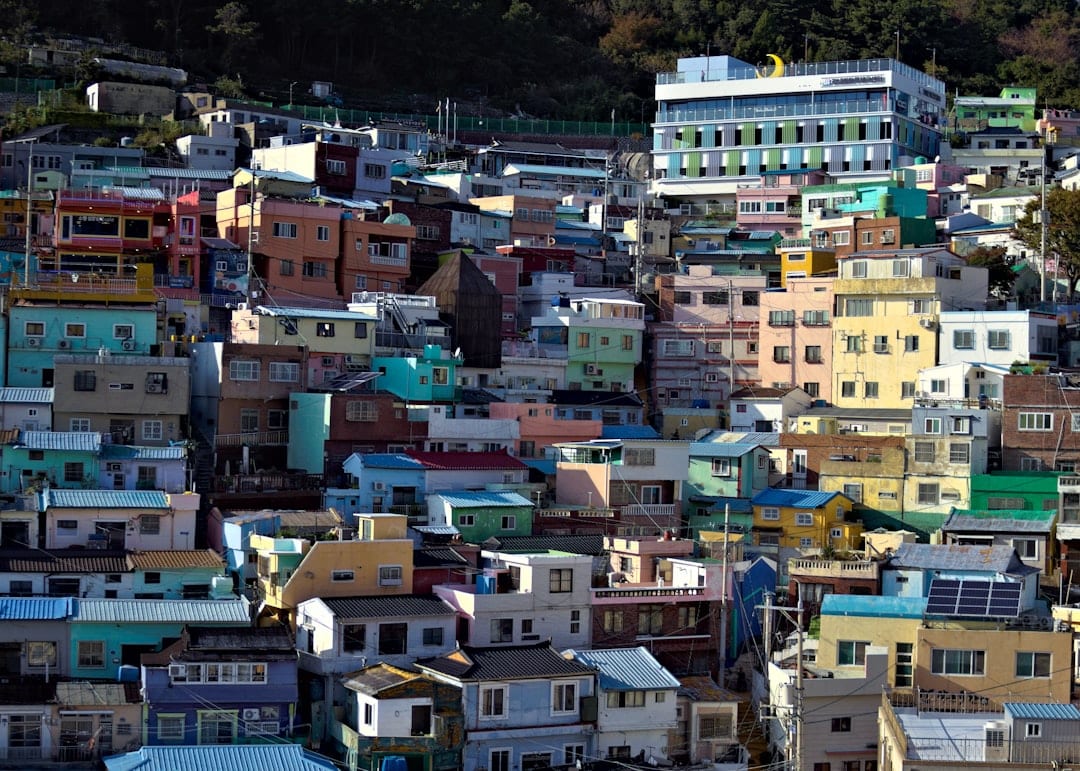
Gamcheon Culture Village — painted alleyways and mural-lined staircases cascading down the hillside.
Originally a hillside settlement for refugees during the Korean War, Gamcheon was transformed in 2009 by a public art project that turned its concrete houses into a cascade of color. Today it is a maze of painted alleyways, sculpture gardens, and rooftop viewpoints.
Navigation tips:
- Pick up a paper map at the Tourist Information Center near the village entrance for 2,000 KRW. It doubles as a stamp-collecting passport — locate all nine stamp points and you earn a free postcard.
- The main walking route is one-way downhill. Follow the painted fish arrows on the ground to avoid climbing back up steep staircases.
- Key photo stops include the Little Prince and Fox statue (expect a short queue), the Sky Garden overlook, and the Bookstore Cafe with its stacked-window facade.
- Wear comfortable shoes with grip. The alleys are steep, and the painted murals do not make the stone steps any less slippery after rain.
Budget two to three hours for Gamcheon. If your legs are tired afterward, taxis regularly wait at the village base to take you back to Toseong Station for about 5,000 KRW (~210 PHP).
Where to Stay: Districts and Budgets
Busan is a long city stretched along the coast, so your base determines your evenings. Here is how the three main accommodation districts compare for a two-night stay.
| District | Vibe | Budget per Night (PHP) |
|---|---|---|
| Haeundae | Beachfront hotels, nightlife, sunrise walks | Mid-range: 4,500–7,500 Luxury: 10,000+ |
| Seomyeon | Central transport hub, shopping, business hotels | Budget: 2,100–3,400 Mid-range: 3,800–6,300 |
| Nampo-dong / Jagalchi | Traditional markets, street food, port access | Budget: 1,700–2,900 Mid-range: 3,400–5,400 |
Filipino traveler tip: If you are following this exact itinerary, Haeundae is the most convenient base for Day 1's temple and coastal walk, while Nampo-dong puts you within walking distance of Jagalchi Market on Day 2. Splitting your nights — one in each — is worth the extra check-in if you want to minimize morning transit.
Weather by Season and What to Pack
Busan's coastal position moderates temperatures compared to Seoul, but each season demands different preparation.
Spring (March–May)
Mild days between 12°C and 20°C. Cherry blossoms peak in early April along Dalmaji-gil. Pack a light jacket, comfortable walking shoes, and a compact umbrella — spring rain is common.
Summer (June–August)
Humid and hot, reaching 28°C–32°C. This is monsoon season (jangma), with heavy rain in July. The beach is swimmable, but temple visits are sweaty affairs. Pack breathable fabrics, sunscreen, a wide-brimmed hat, and a reliable rain jacket. Hydrate constantly.
Autumn (September–November)
The ideal window. Clear skies, 15°C–24°C, and dry air. Fall foliage reaches Gamcheon's trees by late October. Pack layers — a merino base layer, light fleece, and a windbreaker for coastal gusts.
Winter (December–February)
Cold but rarely freezing, averaging 0°C–8°C. Snow is possible but melts quickly near the coast. The advantage is empty temples and off-season hotel rates. Pack a down jacket, thermal underlayers, warm socks, and gloves. Heated subway seats become your best friend.
Insider Tips: What Most Guides Miss
- T-Money works everywhere: The same card you used in Seoul functions on Busan Metro and city buses. Load it at any convenience store or station kiosk.
- Download Naver Map, not Google Maps: Google Maps has limited accuracy for Korean transit. Naver Map provides real-time bus arrivals, walking routes through Gamcheon's alleys, and accurate hiking trail times for Dalmaji-gil.
- Breakfast is different here: Many local restaurants do not open until 9:00 or 10:00 AM. Convenience store gimbap and triangle kimbap are reliable early-morning fuel before a 7:00 AM temple departure.
- The Busan Pass exists: If you plan to visit additional attractions like the Sky Capsule or Busan Tower, the Busan Visit Pass (24-hour or 48-hour) can save money. It does not cover Jagalchi meals, but it includes transport discounts.
- Respect temple silence: At Haedong Yonggungsa, keep voices low near the prayer halls. The site is popular with Instagram tourists, but it remains an active place of worship.
Need help piecing together the Seoul-to-Busan connection, or want a local guide to navigate Jagalchi's second floor with confidence? Mesho's Korea specialists handle the logistics so you can focus on the experience.
Quick Summary: Your 2-Day Busan Cheat Sheet
- Transport: KTX from Seoul Station costs ~2,500 PHP and takes 2h 15m. Book 3–5 days ahead via KorailTalk.
- Day 1: Haedong Yonggungsa (Metro Line 2 + bus 181) at 7:00 AM, then Dalmaji-gil coastal walk from Mipo to Cheongsapo for sunset.
- Day 2: Jagalchi Market (Metro Line 1, Nampo Station) for seafood lunch, then Gamcheon Culture Village via mini bus 2 from Toseong Station.
- Stay: Haeundae for beaches and coastal access; Nampo-dong for market proximity and lower rates.
- Best seasons: Autumn (September–November) for clear skies and foliage; spring (April) for cherry blossoms.
Related Reading
- Seoul, Busan & Jeju: The Perfect 10-Day South Korea Itinerary for Filipino Travelers — A longer circuit if you have more time to explore.
- Seoul Subway and T-Money Card: A Filipino First-Timer's Guide — Master the transit card that powers both Seoul and Busan.
- South Korea Visa Requirements for Philippine Passport Holders in 2026 — Ensure your paperwork is sorted before you book that KTX ticket.
Ready to go beyond Seoul? Let Mesho curate your Busan extension — from KTX reservations and metro-ready itineraries to guided temple walks and market dining experiences that skip the language barrier.
About the author: Grace Villareal is Mesho's Taipei-based Northeast Asia travel editor. She has spent years crisscrossing Korea's coastlines and border zones, and she still believes Busan's 6:00 AM temple light is worth every minute of lost sleep.


