


You have just landed at Incheon International Airport, boarded the airport train, and stepped out at Seoul Station. Suddenly you are facing a cavernous hall, a wall of Korean characters, and a rainbow of subway lines snaking across a massive map. Your phone data is not working yet, and the signs for Line 1, Line 4, and the Airport Railroad all seem to point in different directions. If your heart rate just spiked, you are not alone.
Seoul's subway is one of the most efficient metro systems on the planet, but its scale can feel overwhelming when you are juggling jet lag, luggage, and a language you do not read. This guide was written specifically for Filipino first-timers. We will walk you through buying and reloading a T-Money card, reading subway maps without panic, transferring between lines, and following local etiquette so you move through Seoul with clarity and confidence.
Getting Your T-Money Card: Where, How, and How Much
The T-Money card is Seoul's rechargeable transit smart card. It works on subways, buses, and even in some convenience stores and taxis. Think of it as your Beep card, but for all of Korea.
Where to Buy
- Incheon Airport: Look for convenience stores (CU, GS25, 7-Eleven) on the arrival floor, or use the vending machines near the Airport Railroad entrance.
- Any subway station: Ticket vending machines with English language options sell cards at most entrances.
- Convenience stores citywide: Every CU, GS25, or 7-Eleven stocks them.
Cost Breakdown (KRW and PHP)
| Item | KRW | PHP (approx.) |
|---|---|---|
| T-Money Card (basic) | 3,000 | ₱125 |
| T-Money Card (design/premium) | 4,000 – 5,000 | ₱165 – ₱210 |
| Minimum reload | 1,000 | ₱42 |
| Base subway fare (adult) | 1,400 | ₱58 |
| Typical cross-town fare | 1,500 – 1,700 | ₱62 – ₱71 |
| AREX Airport Express | 9,500 | ₱395 |
How to Reload
- At station machines: Tap your card, press the English button, insert cash, and confirm.
- At convenience stores: Hand your card and cash to the cashier. Say "T-Money chung-jeon hae-joo-se-yo" (T-Money recharge, please).
- Machines accept notes up to 50,000 KRW, but smaller bills are easier.
Pro tip: The card itself is non-refundable, but you can recover your remaining balance. Convenience stores refund up to 20,000 KRW (₱830). For larger amounts, visit a T-Money service center or register your card online before departure.
Reading the Seoul Subway Map Like a Local
Seoul's subway has 9 numbered lines plus several metro extensions and commuter rail lines. Once you understand the color code and numbering logic, navigation becomes intuitive.
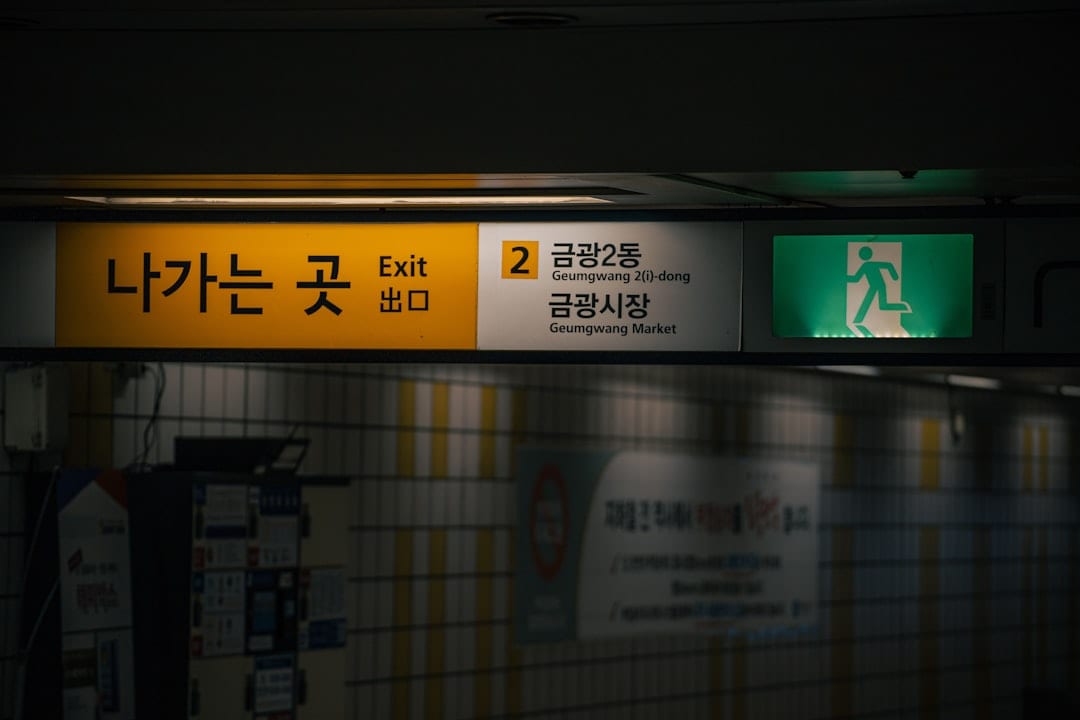
Directional signage inside Seoul Station connecting multiple lines and exits.
- Color coding: Each line has a distinct color. Line 1 is navy blue. Line 2 (the circle line) is bright green. Line 3 is orange. Line 4 is sky blue. Memorize the color of your hotel line.
- Station numbers: Every station has a unique number. For example, City Hall on Line 1 is 132; on Line 2 it is 201. The first digit is the line number. This is incredibly useful when maps switch to Korean-only.
- Terminal direction: Instead of "northbound" or "southbound," Seoul uses terminal station names. A Line 4 train might be headed toward Danggogae or Oido. Check the terminal name on the platform screen to confirm you are on the correct side.
- Express vs. All-Stop: Some lines, like Line 1 and the Gyeongui-Jungang Line, run express trains that skip stations. Listen for announcements and check platform indicators. Express trains are marked in red or with an "E" symbol.
Navigating Transfer Stations Without Panic
Transfers are where most first-timers get lost. Some stations require a 30-second walk; others, like Seoul Station or Dongdaemun History & Culture Park, involve long underground corridors.
Major Transfer Hubs to Know
- Seoul Station: Connects Line 1, Line 4, the Gyeongui-Jungang Line, and the Airport Railroad (AREX). Follow the orange AREX signs carefully; the express train platform is separate from the all-stop platform.
- City Hall: Transfers between Line 1 and Line 2. Short walk, well-signed.
- Dongdaemun History & Culture Park: Connects Line 2, Line 4, and Line 5. A longer underground passage, but color-coded floor signs guide you.
- Hongik University (Hongdae): Line 2, Gyeongui-Jungang Line, and Airport Railroad. Very busy on weekends; follow the crowd flow.
- Gangnam: Line 2 and the Shinbundang Line. Huge station with many exits; know your exit number before you surface.
Transfer Rules
- Transfers within the paid area are free. Do not tap out between lines unless you are exiting the station.
- You have 30 minutes to transfer before the system treats it as a new journey. In practice, this is rarely an issue.
- Look for the colored stripes on the floor and overhead signs showing your target line's color. Trust the arrows.
Korean Subway Etiquette Every Filipino Should Know
Seoul subway culture is orderly and quiet. Observing these unwritten rules will earn you respectful space rather than annoyed stares.
- Priority seats are sacred: The seats at each end of the carriage, marked in pink or yellow, are for the elderly, pregnant women, injured passengers, and parents with small children. Do not sit there even if the train is empty. Locals will avoid them instinctively.
- Silence your phone: Calls are effectively forbidden on the train. Texting is fine, but voice calls draw glares. Many carriages have signs asking you to switch to vibrate mode.
- Escalator etiquette: In Seoul, stand on the right, walk on the left. Watch what locals are doing, as Busan reverses this rule. Keep to one side so commuters can rush past.
- No eating or drinking: A sip of water is acceptable, but snacking on the train is considered rude.
- Queue at platform markings: Yellow footprints on the platform floor show where doors will open. Stand in two neat lines and let passengers off before boarding.
- Backpacks off your back: In crowded trains, swing your backpack around to your chest or place it on the floor between your feet. This prevents you from bumping seated passengers.
- Offer your seat: If you see an elderly person standing and the priority seats are full, offering your regular seat is a gracious gesture that reflects well on Filipino travelers.
Operating Hours, Last Trains, and Airport Connections
Seoul's subway does not run 24 hours. Missing the last train means an expensive taxi ride, so timing matters.
Standard Operating Hours
- First trains: Approximately 5:30 AM from terminus stations.
- Last trains: Between 11:30 PM and 12:30 AM, depending on the line and the station's distance from the terminus.
- Friday and Saturday nights: Some lines on major corridors extend last trains by 30–60 minutes, but never count on it.
Airport Railroad (AREX)
The Airport Railroad Express connects Incheon Airport to Seoul Station in the city center.
| Service | Travel Time | Cost (KRW / PHP) |
|---|---|---|
| AREX Express (direct) | 43 minutes | 9,500 / ₱395 |
| AREX All-Stop | 66 minutes | 4,150 – 4,750 / ₱173 – ₱198 |
- The All-Stop train stops at intermediate stations including Hongik University, Gongdeok, and Digital Media City. Use this if your hotel is near those neighborhoods.
- The Express is non-stop and has designated seating. It is worth the extra cost if you are traveling during rush hour with heavy luggage.
- AREX first train from Incheon Airport departs around 5:20 AM; last train departs around 11:40 PM.
Late-night backup: If you miss the last train, night buses operate from Incheon Airport to major districts. Look for the N6001 or N6002 lines, or use Kakao T to book a taxi. A taxi from Incheon to central Seoul costs roughly 60,000 – 80,000 KRW (₱2,500 – ₱3,300).
Planning your trip? Mesho Travel curates end-to-end Korea tour packages that include airport transfers, hotel arrangements near subway lines, and guided metro orientation so you never have to navigate Seoul alone on your first day.
Essential Apps and Offline Tools for Filipino Travelers
Google Maps works poorly for transit directions in South Korea due to local mapping regulations. Download these alternatives before you leave Manila.
Navigation Apps
- Naver Map: The gold standard. Set the language to English in settings. It shows real-time train arrivals, optimal exits, and walking directions from stations. You need a foreigner registration or Apple ID/Google account to set English mode smoothly.
- KakaoMap / KakaoMetro: Excellent for subway-specific navigation. KakaoMetro is a dedicated subway app with offline route maps. KakaoMap covers walking and bus connections.
- Subway Korea (by Brovu): Works entirely offline. Download the Seoul map before your flight. Perfect for when you have no data or Wi-Fi.
Taxi and Transport Apps
- Kakao T: Korea's equivalent of Grab. You can book taxis without a Korean phone number by using the "Pay to Driver" option. Essential for late-night emergencies when the subway is closed.
- Google Translate: Download the Korean language pack for offline camera translation. Point your camera at signs for instant English overlays.
Pro Setup Tips Before You Fly
- Screenshot your hotel address in Korean and English. Show it to taxi drivers or station attendants.
- Save offline maps in Naver Map for central Seoul neighborhoods: Myeongdong, Hongdae, Gangnam, Insadong, and Jamsil.
- Buy a Korean SIM card or rent a pocket Wi-Fi at Incheon Airport. Having live data makes app navigation seamless.
Quick Summary: Your Seoul Subway Checklist
- Buy a T-Money card at Incheon Airport or any convenience store for 3,000 KRW (₱125) and load at least 10,000 KRW (₱415) to start.
- Memorize your hotel's line color and station number. Follow terminal station names to confirm train direction.
- Stand right on escalators, keep phones on silent, and never sit in priority seats.
- Last trains run around midnight; plan airport arrivals before 11:00 PM to catch the AREX or subway.
- Download Naver Map and Subway Korea before leaving Manila for offline navigation.
"Seoul's subway looks intimidating from the outside, but it is arguably the most beginner-friendly metro in East Asia once you understand the color system and etiquette. The city was built around these lines."
Related Reading
- Seoul Searching: The Perfect 5-Day Itinerary for Filipino K-Culture Fans — Map out your days around the subway lines you now know how to ride.
- South Korea Visa for Filipinos 2026: Step-by-Step Application Guide and Requirements — Get your paperwork sorted before you book that flight.
- South Korea for First-Time Travelers from Manila: Your Essential 2026 Planning Guide — The broader picture: flights, weather, packing, and budgeting.
Ready to Navigate Seoul with Confidence?
You have the map logic, the card know-how, and the etiquette to move through Seoul like someone who belongs there. The only thing left is to book the trip. Explore Mesho Travel's Korea tour packages — from K-culture deep dives to autumn foliage circuits — and let us handle the logistics while you focus on the journey.
Ready to experience Seoul? Let Mesho curate your journey.
About the Author: Grace Villareal is Mesho Travel's Taipei-based Northeast Asia travel editor. With years of experience reporting on border entry details, transit systems, and cultural etiquette across Korea, Japan, Taiwan, and Greater China, she writes guides that turn first-time nerves into first-day confidence.


