


The moment you step out of Little India MRT station, Singapore shifts. The sterile precision of the Orchard Road malls gives way to a sensory current you cannot ignore: jasmine garlands swinging from bamboo poles, turmeric staining wooden countertops gold, and Tamil pop music spilling from shops selling silk saris in colors so vivid they seem lit from within. This is not the Singapore of guidebook thumbnails. This is the Singapore that Filipino travelers often miss—and the one that stays with you longest.
In just under three kilometers, you can walk from the Indian heart of Serangoon Road to the Malay-Arab soul of Kampong Glam, tracing the multicultural threads that make Singapore one of Southeast Asia's most layered cities. This guide gives you the exact streets, the dishes worth queuing for, and the etiquette that turns a casual stroll into a genuine cultural immersion. Whether you are on a Singapore stopover or a longer city break, set aside half a day for this walk.
Historical Context: How Two Communities Shaped Modern Singapore
Before the skyscrapers, Singapore was a patchwork of immigrant settlements. Little India began in the 1820s as a cattle-trading settlement along Serangoon Road. Indian convict laborers brought by the British were later joined by traders, moneylenders, and merchants from Tamil Nadu, Kerala, and Gujarat. By the early 20th century, the area had become a self-contained community with its own temples, mosques, and markets. The name itself is relatively modern—older maps label the area Chulia Kampong, after the Chulia Muslim traders who lived alongside Hindu laborers.
A short walk southeast, Kampong Glam carries an equally royal pedigree. When Stamford Raffles signed the 1819 treaty with Sultan Hussein Shah, he allocated this coastal area to the Sultan and his court. The name combines kampong (village) and gelam (the paperbark tree used for ship caulk). Over time, Arab and Bugis traders settled here, building the shophouses and trading houses that still line Arab Street and Haji Lane. Today, Kampong Glam is Singapore's official Malay-Muslim heritage district, anchored by the gilded Sultan Mosque.
Understanding this history transforms the walk from sightseeing into storytelling. You are not just looking at old buildings. You are walking through two centuries of labor, trade, faith, and reinvention.
The Walking Route: From Serangoon Road to Arab Street
This route covers roughly 2.5 kilometers and takes about three hours with stops. The terrain is completely flat, but Singapore's humidity is relentless—start early, wear breathable clothing, and carry water.
Little India: The Starting Point
Begin at Little India MRT Station (NE7 / DT12), Exit C. Turn right onto Serangoon Road and walk north for two minutes until you reach the intersection with Buffalo Road. Here, Tekka Centre sits under a modern hawker complex—your first food stop. After breakfast, backtrack to Serangoon Road and continue south.
Turn right onto Campbell Lane, a narrow street lined with shops selling religious paraphernalia, gold jewelry, and Bollywood DVDs. At the end of the lane stands the Indian Heritage Centre, a sleek four-story museum that maps the South Asian diaspora in Singapore. Admission is free for Singapore citizens and permanent residents; foreign visitors pay around S$8 (~₱330). Even if you skip the interior, the building's architectural facade—designed to evoke a stepwell—is worth pausing for.
Walk back to Serangoon Road and continue south. You will pass Sri Veeramakaliamman Temple on Race Course Road. This is one of Singapore's oldest Hindu temples, built in 1881 by Tamil laborers. Its tiered gopuram (tower gateway) is impossible to miss, covered in vividly painted deities. The temple is dedicated to Kali, the goddess of destruction and protection, and remains an active place of worship.
Crossing to Kampong Glam
From Race Course Road, continue southeast on Kampong Kapor Road, then turn right onto Jalan Sultan. This street acts as a visual bridge between the two neighborhoods. The shophouses gradually shift from Indian textile shops to Malay printing presses and Middle Eastern carpet traders. After about ten minutes, the golden domes of Sultan Mosque (Masjid Sultan) rise above the streetline.
Circle the mosque along North Bridge Road, then turn right onto Arab Street. This is the historic textile strip—still lined with fabric merchants selling silk, organza, and hand-woven songket. At the end of Arab Street, cut through the narrow alley into Haji Lane, where heritage shophouses have been converted into independent boutiques, street-art canvases, and specialty coffee bars.
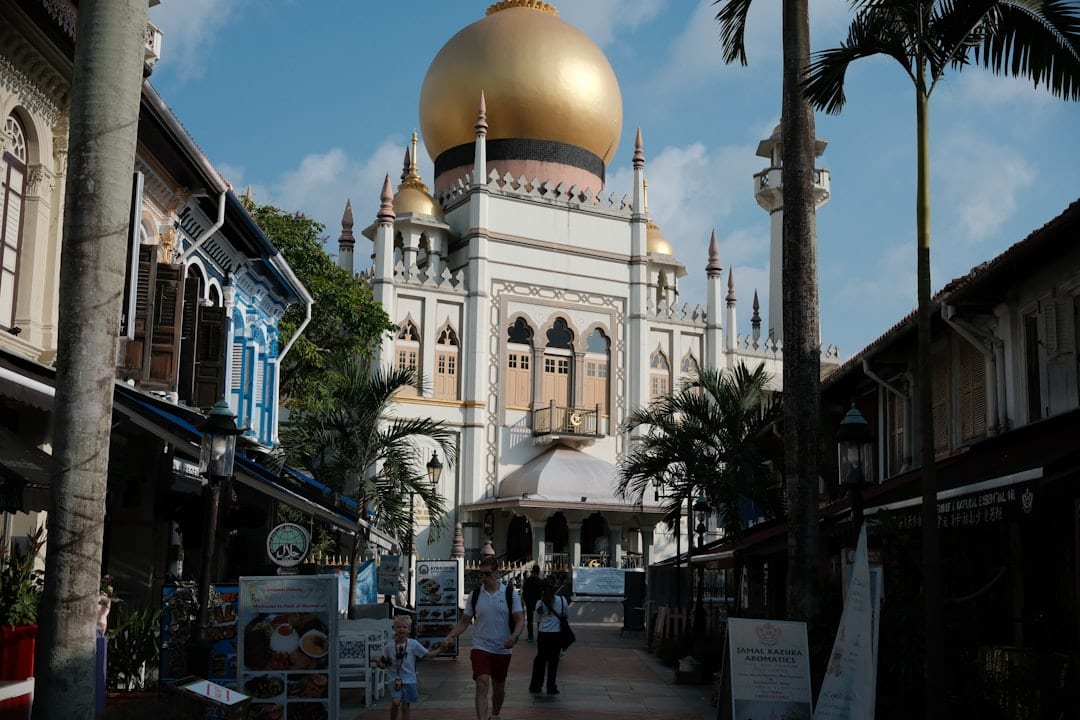
Sultan Mosque viewed from Jalan Sultan, the visual gateway between Little India and Kampong Glam
End your walk at Bugis MRT Station (EW12 / DT14), roughly five minutes from Haji Lane via Victoria Street. If you prefer, you can also start at Bugis and walk north to Little India—just reverse the route.
What to Eat: Tekka Centre and Haji Lane
Food is the most honest way to understand a neighborhood. In both Little India and Kampong Glam, the eating is casual, affordable, and deeply connected to tradition.
Tekka Centre: Little India's Hawker Heart
Tekka Centre on Buffalo Road is a working-class food hall that doubles as a wet market. The upper floor is where you eat. Come hungry and bring cash—many stalls do not accept cards.
- Biryani. Look for stalls serving Tamil-style chicken or mutton biryani layered with basmati rice, hard-boiled egg, and cucumber raita. A generous plate costs S$6–8 (~₱250–330). Arrive before 11:00 AM for the freshest batches.
- Prata. The South Indian flatbread is a breakfast institution. Order it plain or with egg (prata telur) and dip it in fish curry. Expect to pay S$1.20–2.50 (~₱50–105). Some stalls offer coin prata—small, crispy, and perfect for sharing.
- Thosai. A fermented rice-and-lentil crepe served with sambar and coconut chutney. It is lighter than prata and naturally vegan. Price: S$2–3 (~₱80–125).
- Teh Tarik. The national drink of Singapore's Indian-Muslim community—black tea pulled between two cups until frothy. Order it hot and sweet. S$1.20–1.50 (~₱50–60).
Kampong Glam: From Murtabak to Third-Wave Coffee
By the time you reach Kampong Glam, you will be ready for a second meal or at least a long, air-conditioned break.
- Murtabak at Zam Zam. Located on North Bridge Road, just steps from Sultan Mosque, Zam Zam has been serving murtabak since 1908. The stuffed pancake—filled with minced mutton, chicken, or egg—is pan-fried until crispy and served with a side of curry gravy. A full portion costs S$6–9 (~₱250–370). This is a Singapore institution; do not skip it.
- Nasi Padang. Several Malay-Indonesian restaurants along Arab Street serve nasi padang—steamed rice with a choice of curries, rendang, and vegetable sides. Point to what looks good behind the glass; you pay by the number of dishes. Budget S$8–12 (~₱330–500) for a filling plate.
- Haji Lane Cafes. For specialty coffee and modern desserts, the narrow shophouses of Haji Lane hide dozens of independent cafes. A flat white or cold brew runs S$5–7 (~₱210–290). The contrast between traditional Arab Street and the hipster energy of Haji Lane is one of Singapore's most satisfying cultural juxtapositions.
Planning your Singapore routing? Mesho Travel curates Singapore stopover packages that include guided neighborhood walks, MRT passes, and hawker food tours tailored for Filipino travelers.
Sacred Spaces: Etiquette for Sultan Mosque and Hindu Temples
Both neighborhoods are defined by their places of worship. Visiting them respectfully is not just good manners—it is the fastest way to move from tourist to guest.
Sultan Mosque
The mosque is open to non-Muslims outside of prayer times. Entry is free, but modest dress is mandatory. Men and women must wear clothing that covers shoulders and knees. If you are in shorts or a sleeveless top, the mosque provides robes and sarongs at the entrance at no charge.
Remove your shoes before entering the prayer hall. Walk quietly, speak softly, and avoid walking directly in front of anyone who is praying. Photography is permitted in the courtyard and prayer hall, but never point your camera at worshippers without permission. Friday afternoons (12:00 PM–2:00 PM) are reserved for congregational prayers; the mosque may be closed to tourists during this window.
Hindu Temples in Little India
Sri Veeramakaliamman Temple and the nearby Sri Srinivasa Perumal Temple welcome respectful visitors. Shoes must be removed before crossing the threshold—watch for the designated shoe racks outside. Dress modestly; shorts and tank tops are discouraged. Some temples prohibit leather items inside, so leave your leather belts and bags at the entrance if asked.
Inside, circumambulate clockwise. Photography is generally allowed in the outer courtyard but restricted in the inner sanctum where the main deity resides. If a priest is performing a ritual, observe quietly from a distance. Do not touch offerings or statues unless invited.
"The temples and mosques here are not museums. They are living rooms. If you enter with curiosity and humility, the custodians will often share stories no guidebook can offer."
When to Go and How to Get There
Singapore's tropical climate means heat and humidity year-round, but timing still matters for this walk.
Best times: Start at 8:30 AM to beat the midday heat and catch Tekka Centre at its liveliest. Alternatively, begin at 4:00 PM to photograph the shophouses in golden light and end at Sultan Mosque just before the evening call to prayer, when the golden dome glows amber. Haji Lane's cafes and bars are most atmospheric from late afternoon onward.
What to avoid: The week of Deepavali (October/November) transforms Little India into a spectacular but extremely crowded festival ground. Visit during this period only if you are comfortable with shoulder-to-shoulder crowds. Similarly, Friday afternoons at Sultan Mosque are best observed from the outside.
MRT access:
- Start: Little India Station (NE7 / DT12)—North-East Line or Downtown Line
- End: Bugis Station (EW12 / DT12)—East-West Line or Downtown Line
- Alternative end: Nicoll Highway Station (CC5)—Circle Line, useful if you are continuing toward Marina Bay
Budget estimate: MRT fares within the city center run S$1–2 (~₱40–80) per ride using an EZ-Link card. Food across both stops should total S$12–20 (~₱500–830) per person for a generous breakfast and lunch. The Indian Heritage Centre charges S$8 (~₱330). Everything else—the mosques, temples, and street wandering—is free.
Insider Tips for Filipino Travelers
- Carry cash. Hawker stalls and small shops in both neighborhoods prefer cash. Singapore dollars are easy to change at Mustafa Centre, the 24-hour megastore in Little India, which often offers better rates than airport counters.
- Buy a Tourist SIM or eSIM. Free Wi-Fi is available at many cafes, but offline maps help when navigating the narrow lanes of Haji Lane.
- Mustafa Centre is your midnight backup. Open 24 hours, this department store on Syed Alwi Road sells everything from pharmaceuticals to luggage. It is chaotic but weirdly comforting if you need supplies after 10:00 PM.
- Respect the fasting month. If you visit during Ramadan, be discreet about eating and drinking in public near Sultan Mosque during daylight hours. Many Muslim-owned restaurants remain open, but sensitivity goes a long way.
- Philippine passport holders do not need a visa for Singapore stays of up to 30 days. Ensure your passport has at least six months' validity.
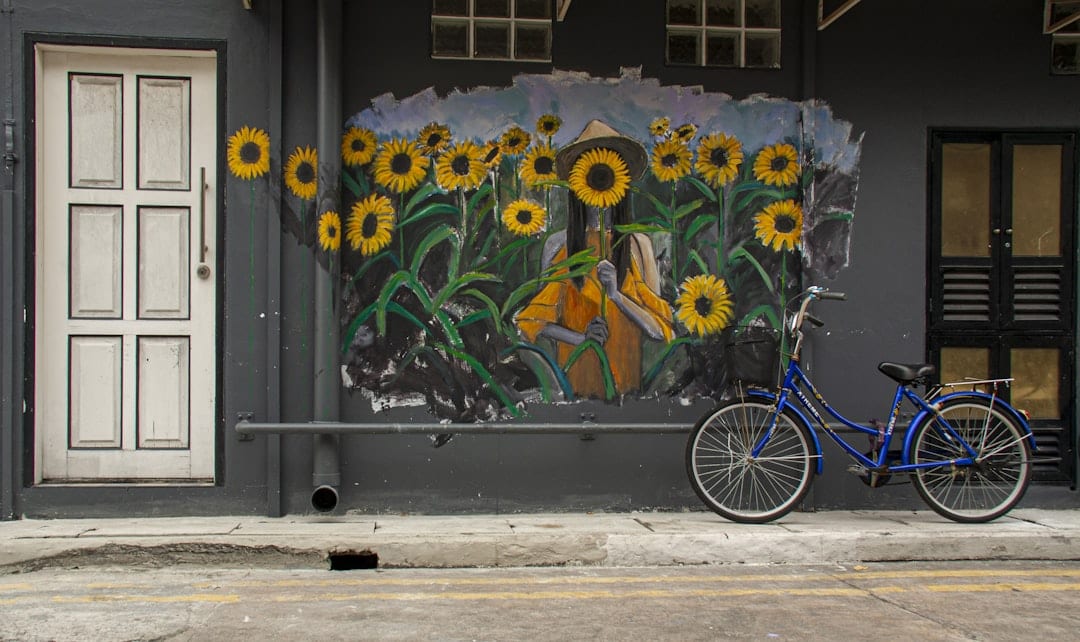
Heritage shophouses along Haji Lane, where traditional Malay architecture meets contemporary street art
Quick Summary: Your Little India to Kampong Glam Walk
- Start at Little India MRT (NE7/DT12), walk Serangoon Road → Buffalo Road → Tekka Centre → Campbell Lane → Race Course Road.
- Cross to Kampong Glam via Kampong Kapor Road → Jalan Sultan, ending at Bugis MRT (EW12/DT14).
- Must-try foods: biryani and prata at Tekka Centre; murtabak at Zam Zam; coffee in Haji Lane.
- Cover shoulders and knees for Sultan Mosque; remove shoes and leather items at Hindu temples.
- Total budget: roughly S$20–30 (~₱830–1,250) per person including food, transit, and one museum.
Related Reading
If this walk leaves you hungry for more of Singapore and its neighbors, explore these next:
- Singapore to Malaysia: A 5-Day Land Crossing Itinerary for Filipino Travelers
- Singapore Travel Guide: Destinations, Visas, and Essentials
Author's Note
I have walked this route more times than I can count, and it never feels the same. One morning you might catch a wedding procession leaving Sri Veeramakaliamman Temple; the next, an impromptu conversation with a carpet merchant on Arab Street who insists you try his Turkish coffee. That unpredictability is the point. Singapore is often reduced to its skyline, but its real character lives in these streets—garlands and calligraphy, prata dough and prayer rugs, all sharing the same humid air.
— Marco Dela Cruz
ASEAN Travel Consultant, Mesho Travel And Tours
Ready to Walk Singapore's Cultural Corridor?
Let Mesho curate your Singapore stopover with guided neighborhood walks, hawker food tours, and seamless MRT routing—designed specifically for travelers departing from the Philippines.
Explore Singapore Packages


