


The first thing that overwhelms most Filipino first-timers in Hong Kong isn't the skyline—it is the MTR map. With its double-decker trams, harbour ferries, bilingual signs, and crowds that move like choreography, the city can feel like a machine you do not yet have the manual for.
This guide is that manual. Written for travelers leaving Meycauayan and landing in Hong Kong for the first time, it covers entry rules, airport-to-city transfers, the Octopus card, the four neighborhoods that matter most, what to eat in each, and a 3-day routing that keeps you on one side of the harbour at a time.
Before You Land: Entry Rules & Airport-to-City Transport
Philippine passport entry requirements
Philippine passport holders can enter Hong Kong visa-free for short visits, typically up to 14 days. Immigration officers may ask for your return or onward ticket, hotel bookings, and proof that you can support yourself during the stay. Keep your passport valid for at least six months beyond your arrival date.
If you are combining Hong Kong with Macau or a mainland China city, the rules change at each border. Mesho's visa team can check whether your routing needs a China visa or qualifies for a transit exemption.
Airport Express vs. airport bus
Hong Kong International Airport is on Lantau Island, about 40 minutes from the city. Your two best first-timer options are the Airport Express train and the Cityflyer bus.
| Option | Best for | Journey time | Rough cost |
|---|---|---|---|
| Airport Express | Speed, luggage, Kowloon/Hong Kong Island hotels | 24 min to Hong Kong Station | ~HKD 115 (~PHP 860) |
| Cityflyer bus A21 | Budget, Tsim Sha Tsui hotels, window views | ~75 min to TST | ~HKD 35 (~PHP 260) |
The Airport Express is faster and more expensive; the bus lets you see the city unfold from the window and drops you closer to many Tsim Sha Tsui guesthouses. Both accept the Octopus card.
Getting Around: MTR & Octopus Card
The Octopus card is your wallet
Buy an Octopus card at the airport MTR counter or any 7-Eleven. The stored-value card covers trains, buses, trams, ferries, convenience stores, and even some restaurants. A refundable deposit is held, so return the card at the end of your trip to claim it back.
- Where to buy: Airport Arrivals MTR counter, 7-Eleven, Circle K
- Top-up: MTR stations, convenience stores, Octopus app
- Refund: Any MTR Customer Service Centre before departure
MTR lines every first-timer should know
You do not need to memorize the whole network. These five lines handle almost every first-timer itinerary:
- Airport Express — Airport to Hong Kong/Kowloon stations; the fastest link after landing.
- Tsuen Wan Line (red) — Tsim Sha Tsui, Mong Kok, Prince Edward, Yau Ma Tei.
- Island Line (blue) — Central, Admiralty, Causeway Bay, Wan Chai.
- Tung Chung Line (orange) — Hong Kong Station to Kowloon and Tung Chung; connects to the Airport Express.
- East Rail Line (light blue) — Useful if you continue north to Shenzhen or visit Sha Tin.
Pro tip: Download the MTR Mobile app and the Citymapper app before leaving Meycauayan. Both work offline for route planning and show the nearest exit for each attraction.
Planning your trip? Mesho can book your flights, hotel, and Octopus-ready airport transfer as part of a Hong Kong tour package. You land with everything already arranged.
Neighborhoods & What to Eat in Each
Hong Kong is best understood neighborhood by neighborhood. Each district has its own rhythm, and the food changes with it. Here are the four areas to prioritize on a first visit.
Central — finance, temples, and old-school dim sum
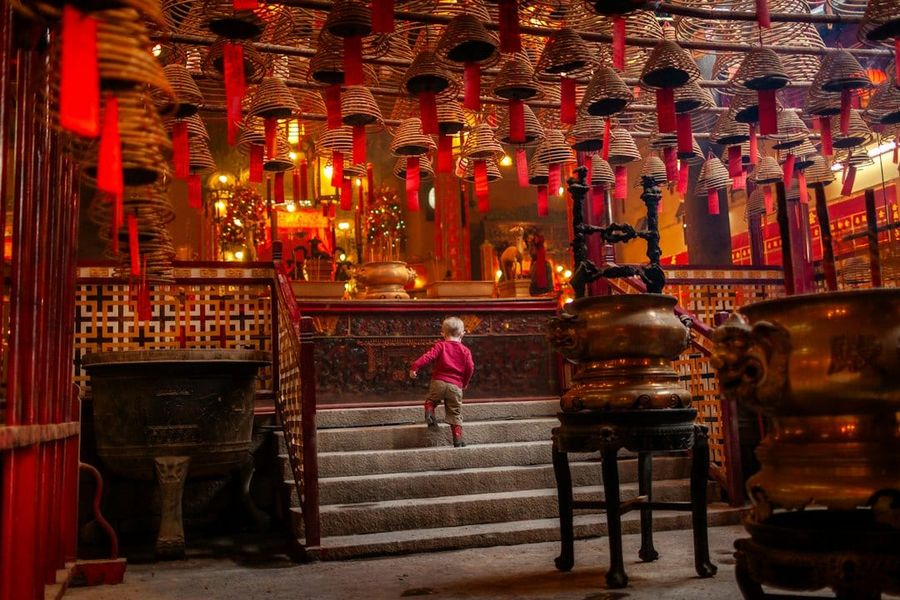
Central is Hong Kong's vertical heart. Start at the Mid-Levels Escalator, the world's longest outdoor covered escalator system, then walk down to Man Mo Temple on Hollywood Road, where incense coils hang overhead like slow-motion smoke sculptures.
Where to eat: Try Tai Cheong Bakery for egg tarts with a flaky, caramelized crust, or Lin Heung Tea House for traditional dim sum served from trolleys in a noisy, no-frills hall. For a quick lunch, the IFC Mall food court has reliable options with harbour views.
Tsim Sha Tsui — the harbour front and classic skyline views
Tsim Sha Tsui, or TST, is where you stand on the Kowloon waterfront and photograph the famous Hong Kong Island skyline. Walk the Avenue of Stars, take the Star Ferry across to Central for a few Hong Kong dollars, and browse K11 MUSEA for design, books, and rooftop views.
Where to eat: Mak's Noodles serves small bowls of springy wonton noodles—order the classic wonton mein. For dessert, Hui Lau Shan is a dependable chain for mango sago and Chinese dessert soups.
Mong Kok — markets, neon, and street snacks
Mong Kok is dense, loud, and impossible to ignore. The Ladies Market on Tung Choi Street is the go-to for souvenirs, bags, and electronics accessories. Nearby, Sai Yeung Choi Street glows with neon and street performers, while Sneakers Street draws shoe hunters.
Where to eat: Kam Wah Cafe is famous for the bo lo yau—a warm pineapple bun split and filled with a thick slab of cold butter. Pair it with milk tea. For dim sum, One Dim Sum near Prince Edward is a local favorite with short queues outside peak hours.
Stanley — the outlier with sea breeze and market stalls
If you want to see a slower, more suburban side of Hong Kong, take bus 6 or 260 from Central Exchange Square to Stanley. The winding coastal road offers glimpses of beaches and mansions before dropping you at the waterfront.
What to do: Wander Stanley Market for silk, linen, and souvenirs, then visit Murray House, a colonial building moved brick by brick from Central. Where to eat: The Boathouse has harbour-facing tables and a relaxed brunch menu, while the Stanley Food Court offers cheaper Asian options.
"Hong Kong rewards the traveler who groups things by district. Cross the harbour once a day, not five times, and the city starts to feel small."
Budgeting in PHP, Safety & Etiquette
What to budget per day
Hong Kong is not Southeast Asia-cheap, but it is manageable if you mix local eats with one splurge meal. These estimates assume you already paid for your hotel.
| Expense | Budget range | Notes |
|---|---|---|
| Meals | PHP 400 – 1,500/day | Local cafes lower; hotel restaurants and harbour-view dining higher. |
| Transport | PHP 300 – 700/day | MTR rides are efficient; Star Ferry and trams are cheap. |
| Attractions | PHP 400 – 1,800/day | Markets and temples are free; Peak Tram combo and paid decks cost more. |
| Octopus card load | PHP 1,500 – 3,000 total | Load in chunks; unused balance plus deposit is refundable. |
Safety & etiquette notes
Hong Kong is one of the safest cities in Asia, but crowds are real. Keep your phone and wallet in front pockets in Mong Kok and Ladies Market. Use official taxis or ride-hailing apps, and avoid anyone offering "discount" tours inside the arrivals hall.
- Escalators: Stand on the right, walk on the left.
- MTR: No eating, drinking, or blocking the doors. Let passengers exit first.
- Queues: Filipinos already know this—Hongkongers queue for everything from buses to egg tarts.
- Tipping: Not expected at local restaurants; service charge is often included in hotel restaurants.
- Thanks: Say m goi when someone hands you something; do jeh for gifts or favours.
A 3-Day Hong Kong Routing That Minimizes Backtracking
The secret to a smooth first trip is to stay on one side of Victoria Harbour per day. This routing groups Kowloon on one day, Hong Kong Island on the next, and a relaxed outlier on the last.
Day 1 — Kowloon: arrival, harbour, and markets
- Arrive and take the Airport Express or A21 bus to Tsim Sha Tsui.
- Check in, then walk the Avenue of Stars for the skyline view.
- Ride the Star Ferry to Central and back for the classic harbour crossing.
- Dinner along Nathan Road or a wonton noodle bowl at Mak's Noodles.
Day 2 — Hong Kong Island: Peak, temples, and nightlife
- Take the Peak Tram up to Victoria Peak early to beat the crowds.
- Walk down through the Mid-Levels Escalator to Man Mo Temple.
- Lunch at Lin Heung Tea House or Tai Cheong Bakery.
- Evening drinks or people-watching around Lan Kwai Fong, or a quieter sunset at the IFC rooftop.
Day 3 — Markets and an outlier
- Morning in Mong Kok: Ladies Market, Sneakers Street, and a pineapple bun at Kam Wah Cafe.
- Afternoon bus to Stanley for the market, Murray House, and a seaside late lunch.
- Return to Central and take the Airport Express back to the airport, or extend with an extra night in TST.
Ready to experience Hong Kong without the guesswork?
Let Mesho curate your flights, hotel, transfers, and day-to-day routing. Explore our Hong Kong tour packages or message us on WhatsApp for a custom quote.
View Hong Kong PackagesQuick Summary
- Philippine passport holders can visit Hong Kong visa-free for short stays; carry return tickets and hotel bookings.
- Choose Airport Express for speed or Cityflyer A21 for savings and Kowloon hotel drops.
- Get an Octopus card on arrival and rely on the Tsuen Wan, Island, and Airport Express lines.
- Group Central, Tsim Sha Tsui, Mong Kok, and Stanley into separate days to avoid harbour-hopping.
- Budget roughly PHP 2,500–4,000 per day excluding hotel, mixing local cafes with one special meal.
Related Reading
- Hong Kong & Macau Cultural Highlights: A 4-Day Heritage & Food Tour
- Hong Kong Disneyland vs. Ocean Park: How Filipino Families Can Choose and Plan
- China Visa-Free Transit for Filipinos 2026: 144-Hour Rules & Ports
Author note from Grace Villareal: I have crossed the Hong Kong–Shenzhen and Hong Kong–Macau borders more times than I can count, and the difference between a stressful first trip and a seamless one is almost always routing. Group your days by district, load your Octopus card, and let the city move you. If you want a second pair of eyes on your itinerary, Mesho's Hong Kong team is happy to help.


