


The first time you step onto a curb in Ho Chi Minh City, the sound hits you before the heat does. Hundreds of motorbikes weave past one another in a continuous, humming stream. There are no gaps. There are no lanes. There is only movement. For Filipino travelers used to the disciplined queues of EDSA or the orderly jeepney terminals back home, the sensory shock can be overwhelming. You came for the pho, the history, and the energy of Vietnam's economic heart—but how do you actually get anywhere without getting lost, overcharged, or swept into the current?
This guide breaks down every transport option in HCMC with the practical detail a first-time visitor needs. We will cover Grab setup and real fares, public buses you can actually use, motorbike taxi etiquette and helmet safety, walking strategies for the tropical heat, and the scams to avoid before they find you. Filipinos enjoy visa-free entry to Vietnam for up to 21 days, so the only barrier between you and this city is knowing how to move through it.
Grab: Your Digital Lifeline
If you download only one app before landing at Tan Son Nhat International Airport, make it Grab. The Southeast Asian super-app operates seamlessly in HCMC and is the most reliable way for non-Vietnamese speakers to travel without haggling.
App Setup Before You Land
Set up Grab using your Philippine mobile number. Most Filipino carriers (Globe, Smart, DITO) offer affordable roaming data packages for Vietnam, or you can purchase a local SIM at the airport arrivals hall for roughly 150,000–250,000 VND (approximately 375–625 PHP). Enable your roaming data before departure so you can book your first ride the moment you clear customs. Pro tip: link a credit or debit card in the app to avoid fumbling for exact change after a long flight.
Cash vs. Card
Grab accepts both cash and card in Vietnam, but cash remains the default for most drivers. Keep small bills handy—drivers rarely carry change for large denominations. If you pay by card, the fare is locked in upfront, eliminating any language barrier about the total. For Filipino travelers, cash payment is often more convenient since you can withdraw VND from BIDV or Vietcombank ATMs using your Philippine debit card with minimal forex fees.
Fare Estimates You Can Count On
Here are realistic Grab fares for routes every Filipino first-timer will take:
| Route | VND Fare | PHP Equivalent |
|---|---|---|
| Airport to District 1 (GrabCar) | 150,000 – 200,000 | ~375 – 500 |
| Short trip within District 1 | 50,000 – 80,000 | ~125 – 200 |
| District 1 to District 3 | 40,000 – 70,000 | ~100 – 175 |
| Ben Thanh to Landmark 81 | 60,000 – 100,000 | ~150 – 250 |
These fares include base rates and distance charges but exclude tolls. GrabBike, the two-wheeler option, costs roughly 30–40% less than GrabCar—ideal for solo travelers with light backpacks.
Public Buses: The Local Route
Buses in HCMC are clean, air-conditioned, and shockingly affordable. The challenge is not the ride itself—it is the signage. Bus stops display schedules and route maps exclusively in Vietnamese, which can intimidate first-time visitors. With a little preparation, however, buses become your cheapest window into local life.
Airport to District 1
Two bus routes serve Tan Son Nhat Airport directly:
- Bus 109: The airport express. Runs every 15–20 minutes from 5:30 AM to 1:30 AM. Drops you at 23/9 Park in District 1, a five-minute walk from Pham Ngu Lao backpacker street. Fare: 20,000 VND (~50 PHP).
- Bus 152: The budget option. Runs every 20 minutes from 6:00 AM to 6:00 PM. Stops at Ben Thanh Market. Fare: 10,000 VND (~25 PHP), plus a small surcharge for large luggage.
Look for the yellow airport bus sign directly outside the international arrivals terminal. The attendants stationed there typically understand basic English and will confirm your destination before you board.
Ben Thanh Area and Beyond
Ben Thanh Market functions as the unofficial transport hub of the city. Key tourist-friendly routes include:
- Bus 03: Connects Ben Thanh to Cholon (HCMC's Chinatown) and the Thien Hau Pagoda.
- Bus 04: Links Ben Thanh to Saigon Notre-Dame Cathedral and the Independence Palace area.
- Bus 39: Heads to the War Remnants Museum from the city center.
Decoding Vietnamese-Only Signs
Bus stop signs list routes vertically. The numbers are universal, but the destinations beneath them are in Vietnamese script. Before your trip, screenshot your intended route from the BusMap.vn app or Google Maps. Match the route number on your phone to the number on the pole—ignore the text below. When in doubt, point to your phone screen and ask a local student or office worker. Young Vietnamese in HCMC are often eager to practice English and will gladly confirm you are headed the right way.
Motorbike Taxis: Riding the River
There is no faster way to move through District 1 at rush hour than on the back of a motorbike. The experience is exhilarating, efficient, and—once you understand the etiquette—perfectly safe.
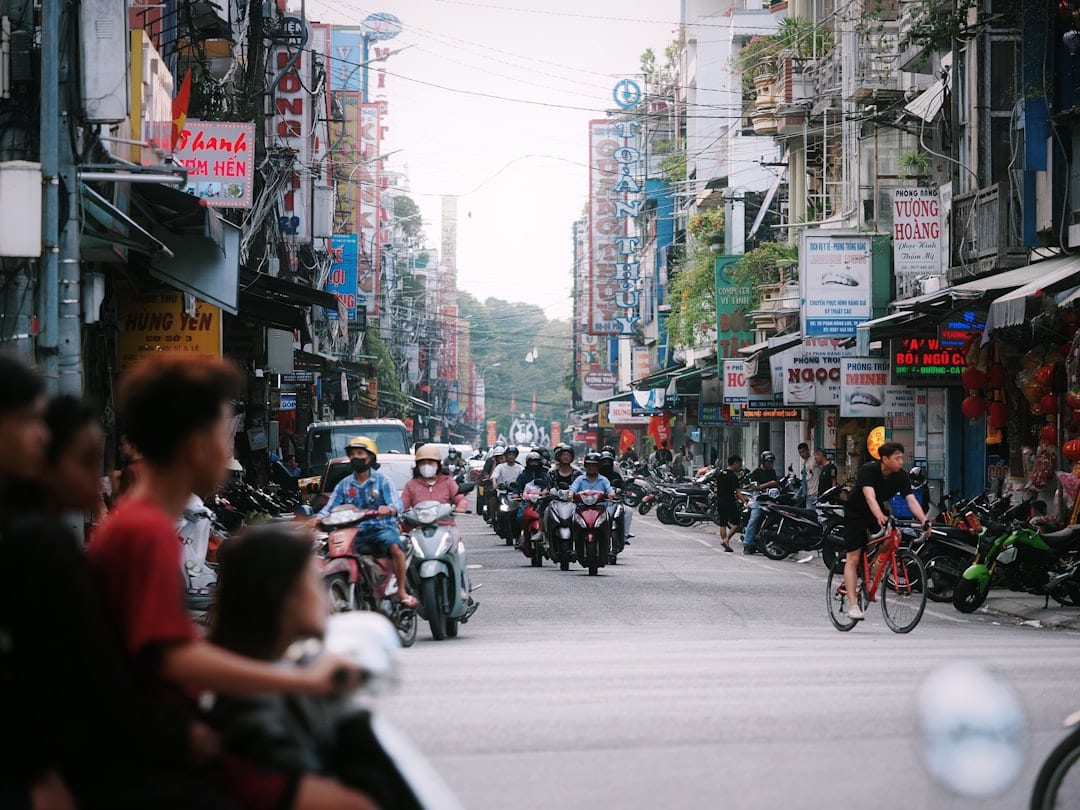
The iconic motorbike flow of District 1—organized chaos that moves like a river once you learn its rhythm.
Go-Viet, Be, and GrabBike
While GrabBike dominates, two strong local competitors exist: Go-Viet and Be. Be, in particular, often runs promotional discounts for first-time users and can be 10–15% cheaper than Grab during off-peak hours. All three apps display the driver's name, plate number, and helmet color before pickup. Book through the app—never flag a motorbike taxi on the street. Unregistered drivers are significantly more likely to overcharge or take indirect routes.
Helmet Safety Non-Negotiables
Vietnamese law requires helmets for both driver and passenger. Reputable app-based drivers always carry a spare. Before mounting, check three things:
- The helmet has a functioning chin strap that clicks securely.
- The shell is not cracked or visibly damaged.
- The helmet fits snugly without wobbling when you move your head.
If the provided helmet feels flimsy, cancel the ride and book another. Your safety is worth the extra two-minute wait.
Etiquette and Positioning
Mount from the left side to avoid the hot exhaust pipe. Place your feet on the rear pegs, keep your knees slightly bent, and hold the rear grab bar or the driver's waist—never their shoulders, as this restricts their steering. Keep your bag in front of you, tucked between your body and the driver, to prevent snatch theft at intersections. Avoid using your phone while riding; distracted passengers make drivers nervous in dense traffic.
Walking in Ho Chi Minh City
Walking is the best way to discover HCMC's hidden coffee shops and French colonial architecture, but it requires strategy. Sidewalks here are not pedestrian sanctuaries—they are extensions of the street itself.
Crossing Strategies
The golden rule: walk slowly and predictably. Never sprint, never stop abruptly, and never backtrack mid-crossing. Motorbike riders anticipate your movement and flow around you like water around a stone. Raise one hand slightly to signal your intention. Make eye contact with the nearest rider when possible. Crosswalks exist but are largely decorative—drivers do not stop for them. Cross in groups when you can; there is safety in numbers, and a cluster of pedestrians is easier for riders to spot than a single person.
Sidewalk Obstructions
Expect sidewalks to function as motorbike parking lots, outdoor dining rooms, construction zones, and merchandise displays. In District 1, entire blocks are impassable on foot. Do not fight it. Step onto the street edge, face oncoming traffic, and walk with purpose. Locals do this constantly; you are not breaking rules—you are adapting to local physics. Wear comfortable, closed-toe shoes. Sandals leave your feet exposed to hot exhaust pipes, uneven tiles, and unexpected puddles during the sudden tropical downpours of monsoon season.
Heat Management
HCMC temperatures hover between 32°C and 35°C year-round with humidity that rivals Manila in April. Schedule your longest walks before 9:00 AM or after 4:00 PM. Carry a reusable water bottle and refill it at your hotel—bottled water costs add up quickly. Convenience stores like Circle K and FamilyMart are everywhere and offer instant air-conditioned refuge. A portable handheld fan, widely sold at Ben Thanh Market for around 50,000 VND (~125 PHP), is the best impulse purchase you will make.
Scams to Watch For
HCMC is generally safe, but transport scams target disoriented tourists within their first 48 hours. Recognize these three common traps before they cost you.
Rigged Taxi Meters
Traditional taxis with tampered meters can inflate fares by 200–300%. Stick to Vinasun (white with green lettering) and Mai Linh (green with white lettering)—the two reputable nationwide companies whose drivers rarely tamper with meters. Better yet, skip street taxis entirely and use Grab, where your fare is locked before the engine starts. If you must take a street taxi, ensure the driver starts the meter at the flag-down rate of 12,000 VND and watch for suspiciously rapid jumps.
Cyclo Overcharging
The pedal-powered cyclos around Ben Thanh Market and the Opera House look charming, but they are a known tourist trap. Drivers often quote 100,000 VND for a short ride, then demand 1,000,000 VND at the destination, claiming the quote was per minute or per person. If you want the experience, negotiate the full price in writing on your phone or a piece of paper before stepping into the seat. Show it to the driver, get a nod, then photograph the driver with their cyclo number. This documentation almost always prevents disputes.
Fake Hotel Shuttles
At the airport arrivals hall, well-dressed individuals holding signs with popular hotel names may approach you offering "complimentary" or "discounted" shuttle services. These are rarely affiliated with your hotel. They often drive you to alternate accommodations paying them commission, or charge exorbitant rates upon arrival. Ignore every unsolicited offer at the airport. Walk directly to the official taxi queue, pre-booked Grab pickup point, or airport bus stop. If your hotel genuinely offers a shuttle, confirm the driver's name and vehicle plate with the front desk via WhatsApp or email before you land.
Planning your trip? If navigating HCMC's transport web feels daunting, Mesho curates fully guided Vietnam experiences where every transfer, ferry, and flight is pre-arranged. Explore our Vietnam Rose Reloaded Luxury Cruise Tour for a seamless, extraordinary journey from Mekong Delta waterways to Halong Bay limestone karsts—no haggling required.
Understanding the Flow: How Traffic Moves Like a River
To move through HCMC confidently, you must rewire your understanding of traffic. In the Philippines, we think in lanes, stoplights, and right-of-way. In HCMC, traffic behaves like a river—an organic, self-organizing current where individual vehicles adjust to one another in real time without central command.
Watch a major intersection during rush hour. There are no traffic enforcers with whistles. No one waits for a green light to turn right. Motorbikes inch forward in a coordinated mass, slipping through gaps barely wider than their handlebars. Cars move slowly but deliberately, never stopping the flow. It looks chaotic from the outside, but there is a deep logic to it: predictability trumps rules. Every participant assumes the others will keep moving, so hesitation is the only real danger.
This cultural context matters because it shapes how you should behave. When crossing, be the predictable stone the river flows around. When riding GrabBike, trust that your driver sees the gap you cannot. When walking, move with the same steady intention as the traffic itself. The moment you embrace the flow rather than fight it, Ho Chi Minh City stops feeling overwhelming and starts feeling electric.
"The traffic in Saigon is not your enemy. It is the city's heartbeat. Once you stop fearing it, you start hearing the rhythm."
Quick Summary: Your HCMC Transport Toolkit
- Download Grab before departure and preload a card. Budget 150,000–200,000 VND (~375–500 PHP) for airport transfers.
- Use Bus 109 or 152 from the airport for the cheapest route to District 1 at 10,000–20,000 VND (~25–50 PHP).
- Book motorbike taxis via apps only (GrabBike, Be, Go-Viet). Always verify the helmet before mounting.
- Cross streets slowly and steadily. Raise your hand, make eye contact, and never hesitate mid-crossing.
- Avoid cyclos without written prices, ignore fake hotel shuttles at the airport, and skip unmarked street taxis.
Related Reading
Ready to go deeper into Vietnam? Here are more guides crafted for Filipino travelers:
- Vietnam E-Visa for Filipinos 2026: How to Apply Online and Validity Updates
- Vietnam North to South: 14-Day Ultimate Itinerary from Hanoi to Ho Chi Minh City
- Hanoi to Halong Bay: A Filipino Traveler's Transport and Booking Guide
Ready to experience Vietnam without the logistics headache? Let Mesho curate your journey. From airport pickups in HCMC to luxury Mekong Delta cruises and curated city walking tours, we handle the routing so you can focus on the discovery. Explore our Vietnam Rose Reloaded Luxury Cruise Tour or consult with our travel specialists to build your perfect Southeast Asia itinerary.
Author's Note from Marco Dela Cruz: As an ASEAN travel consultant, I have routed hundreds of Filipino travelers through Ho Chi Minh City's transport network. The city rewards preparation. Download your apps, screenshot your bus numbers, and pack a sense of curiosity. HCMC's traffic is not chaos—it is a living system, and once you learn its logic, you move through it like a local. Safe travels, and see you on the road.


