


You step off the ferry from Hong Kong expecting glittering casinos. Instead, you find yourself on wave-patterned cobblestones that have carried foot traffic for nearly five centuries. The air smells of cinnamon and baked egg custard. A church bell rings somewhere behind a row of sherbet-colored colonial townhouses. This is the Macau most Filipino travelers miss—the one that existed long before the blackjack tables.
Macau's historic core is compact enough to explore on foot in half a day, yet layered with enough cultural density to fill a week. For Filipino heritage walkers arriving on a Hong Kong–Macau circuit, the route from Senado Square to the Ruins of St. Paul offers the continent's most vivid encounter with Portuguese-Chinese fusion—without a single casino chip in sight. This guide maps every turn, names the bakeries worth your Patacas, and shows you how to time your walk so you hear church bells instead of tour-bus air brakes.
The Route: Senado Square to the Ruins of St. Paul
The entire heritage circuit covers roughly 1.2 kilometers and takes two to three hours at a thoughtful pace, including snack stops and photography. Wear comfortable shoes with grip—the iconic Portuguese calçada cobblestones are beautiful but unforgiving on heels.
Starting Point: Largo do Senado
Begin at Senado Square (Largo do Senado), the civic heart of Macau since the 16th century. The black-and-white wave-pattern pavement immediately signals that you are somewhere between Lisbon and Guangzhou. Look up at the Leal Senado Building—the former seat of Portuguese administration—whose neoclassical facade and arched loggia still host municipal functions today. The salmon-pink, mint-green, and butter-yellow townhouses framing the square are not stage sets; they are functioning shops, pharmacies, and cafés operating inside UNESCO-listed shells.
Walk north toward the Ruins, keeping to the left side of the square. You will pass Santa Casa da Misericórdia, a cream-colored baroque welfare institution founded in 1569. Its quiet courtyard is easy to overlook, but the azulejo tile panels inside narrate Macau's earliest charity work—a useful reminder that this city's history is not only maritime trade, but also caregiving.
St. Dominic's Church and Lou Kau Mansion
Turn right onto Largo de São Domingos to find St. Dominic's Church (Igreja de São Domingos). The yellow-and-green baroque facade, rebuilt in the early 19th century, hides one of Macau's most opulent church interiors: gilt altars, ivory-toned Corinthian columns, and a carved-wood ceiling that feels more São Paulo than Shenzhen. The church houses the Museum of Sacred Art in its attached cloister, where silver processional crowns and 17th-century statuary reveal how Catholic liturgy adapted to Chinese craftsmanship.
Directly opposite the church, duck into Lou Kau Mansion. This late-Qing courtyard residence, built around 1889, illustrates the Chinese merchant response to Portuguese influence: traditional grey-brick siheyuan layout, but with Western-style verandas and imported stained glass. Entry is free, and the second-floor moon-gate windows frame excellent photographs without the crowds you will encounter later.
The Grand Lisboa Viewpoint
Before reaching the Ruins, take the short detour up to the Mount Fortress (Fortaleza do Monte). The climb is steep but brief—about ten minutes up paved ramps. From the fortress walls, you earn Macau's most iconic visual paradox: the golden lotus-shaped Grand Lisboa Hotel rising behind the stone facade of St. Paul's. This single frame captures everything Macau is—colonial stone and casino glass, 17th-century gun emplacements and 21st-century wealth—without needing a caption.
The Ruins of St. Paul: More Than a Facade
Descend from the fortress and follow the stone stairway to the Ruins of St. Paul (Matsua in Cantonese, formally the Cathedral of St. Paul). What survives is not a ruin by accident, but by fire—three fires between 1595 and 1835 consumed the seminary, library, and nave, leaving only the granite facade and its 68-step staircase. Look closely at the carvings: the bottom tier shows Jesuit missionaries accompanied by Chinese figures in Ming-dynasty dress; the middle tier depicts the Virgin Mary flanked by angels and bronze-era weapons; the top tier presents a dove within a bronze sun, a motif that resonated with both Catholic and Confucian audiences.
Behind the facade, steel walkways allow you to view the original foundations and crypt. Do not skip the small Museum of Sacred Art and Crypt to the right of the stairs; it contains the tombstones of 17th-century Jesuits and a silver reliquary that survived the 1835 blaze.
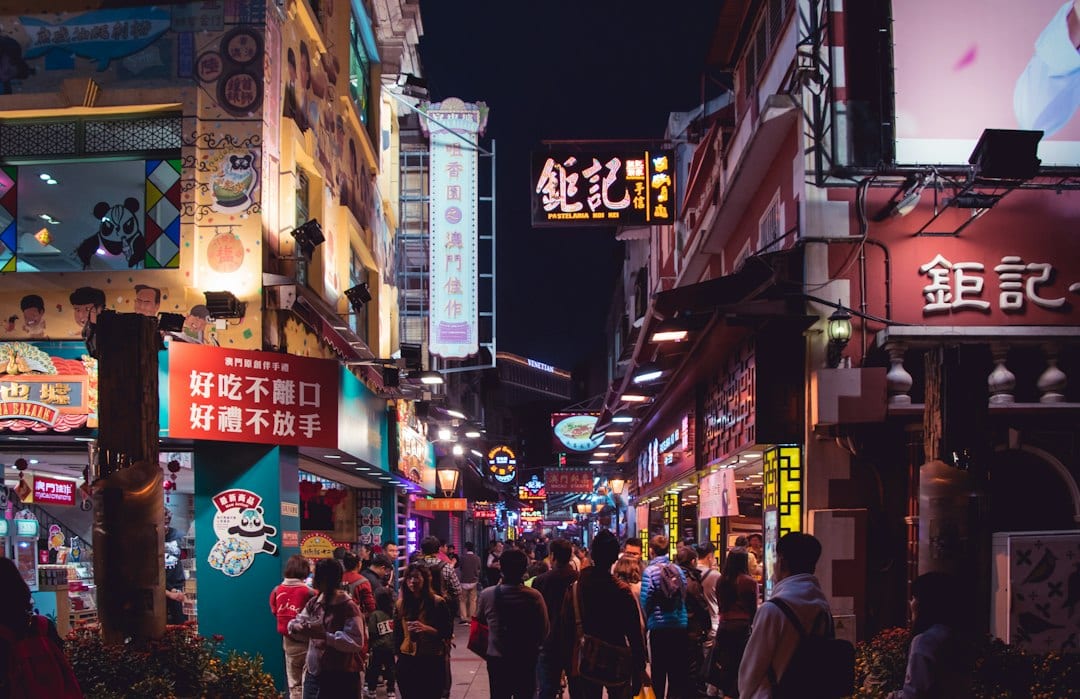
The lively streets near the Ruins of St. Paul, where centuries-old architecture meets everyday Macanese life
A City of Two Worlds: Understanding Portuguese-Chinese Fusion
Macau was not simply colonized; it was leased—first informally in 1557, then formally under Treaty of Peking in 1887—making it the longest-lived European settlement in East Asia until its handover to China in 1999. Unlike Hong Kong's British administrative efficiency, Portuguese Macau developed a creolized culture where Chinese merchants, Fujianese fishermen, Goan clerks, and Macanese Catholic families shared narrow lanes for over four centuries.
This fusion survives most visibly in the architecture. The buildings you walk past are not Portuguese replicas; they are Macanese interpretations of Iberian styles. Notice the green wooden shutters designed for subtropical humidity, the Chinese-inspired roof tiles shaped like rolling waves, and the plaster moldings that imitate European stone but were executed by Cantonese craftsmen using local materials. Even the street names maintain bilingual presence—Rua de São Paulo shares signposts with Ba Da Ling Xie Jie—a daily reminder that this city has always spoken two languages at once.
"Macau is not a museum. It is a living conversation between two civilizations that learned to share a kitchen, a church, and a harbor. The architecture is merely the grammar of that conversation."
What to Eat Along the Route
Macanese cuisine is the only culinary tradition in China recognized by UNESCO as an Intangible Cultural Heritage. Do not leave the historic core without tasting these three essentials.
Portuguese Egg Tart (Pastel de Nata)
The Macanese egg tart differs from its Lisbon ancestor in one crucial way: the local version uses a twice-baked, caramelized custard top that creates a crème brûlée crust. The most reliable name near your route is Margaret's Café e Nata, a short walk from Senado Square toward the Grand Lisboa. A single tart costs roughly 10 MOP (≈ ₱72). Arrive before 10:00 AM; the batch sells out by noon.
Pork Chop Bun (Zyu Paai Bao)
This is street food architecture at its simplest: a deep-fried bone-in pork cutlet jammed inside a toasted Portuguese-style roll. The contrast—crispy savory meat against soft, slightly sweet bread—is what keeps locals queueing. Tai Lei Loi Kei on Rua do Cunha in Taipa is the legendary original, but for this walking route, the vendors near the base of the Ruins of St. Paul stairs serve respectable versions until mid-afternoon. Expect to pay 30–40 MOP (≈ ₱215–290).
Almond Cookies and Beef Jerky Samples
As you approach the Ruins, Koi Kei Bakery staff will press free samples of almond cookies and sweet pork jerky into your hands. These are not tourist gimmicks; Koi Kei is a genuine Macanese institution with roots in the 1930s. A box of almond cookies makes an excellent pasalubong and costs roughly 40 MOP (≈ ₱290). If you prefer something less sweet, look for phoenix egg rolls—crispy wafer cylinders filled with shredded pork floss.
Timing Your Walk for the Best Experience
Macau's historic core is mercilessly small, which means tour buses can saturate it within minutes. Your timing determines whether you experience contemplative heritage or a selfie-stick obstacle course.
- Ideal start time: 7:00 AM to 8:30 AM. The square is nearly empty, the light is honey-gold, and the egg tart bakeries are pulling their first batches from the oven.
- Avoid: 10:00 AM to 3:00 PM. This is when Shenzhen and Guangzhou group tours arrive by the busload. The staircase to the Ruins becomes a single-file human conveyor belt.
- Secondary window: 4:30 PM to 6:30 PM. Tour buses retreat to casino buffets, and the evening light paints St. Dominic's yellow facade in deep amber. Note that the Museum of Sacred Art closes at 6:00 PM.
- Weather watch: Macau summers (June–September) regularly exceed 33°C with 80% humidity. If you must walk midday, carry a parasol and hydrate at every opportunity. December to February offers crisp 18°C mornings ideal for photography.
| Transport Mode | Route | Cost (PHP) | Duration |
|---|---|---|---|
| TurboJET Ferry | Hong Kong–Macau Outer Harbour | ≈ ₱1,200–1,800 | 55 min |
| Casino Shuttle | Ferry Terminal → Grand Lisboa → Walk | Free | 15 min + 10 min walk |
| Taxi | Direct to Senado Square | ≈ ₱500–700 | 10 min |
Filipino passport note: Philippine passport holders receive a 30-day visa-free stay in Macau. No pre-application is required. Carry your return ferry ticket and hotel confirmation for smooth immigration clearance.
Currency tip: The Macanese Pataca (MOP) is pegged to the Hong Kong Dollar (HKD) at roughly 1:1. Most vendors accept HKD, but you will receive change in MOP. For a half-day walk, budget 150–250 MOP (≈ ₱1,100–1,800) for snacks, water, and museum entry. Major credit cards are accepted at bakeries, but street vendors are cash-only.
Planning your Hong Kong–Macau circuit?
Mesho Travel And Tours curates seamless ferry bookings, heritage-guided walks, and casino-free accommodations in Macau's historic Santo António district. Let us handle the logistics so you can focus on the cobblestones.
Respecting Sacred Spaces: Photography and Etiquette
The Ruins of St. Paul and St. Dominic's Church are active sites of memory and, in the case of St. Dominic's, active places of worship. Filipino travelers—many of us raised Catholic—will instinctively understand the atmosphere, but a few reminders ensure your visit honors the space.
- Inside churches: No flash photography. No videos during Mass. Keep voices low even if the interior seems empty; sound carries in baroque spaces.
- Dress code: Shoulders and knees should be covered in St. Dominic's and the crypt behind the Ruins. A light scarf or cardigan in your daypack solves this instantly.
- The Ruins staircase: Avoid sitting on the stone steps for posed photos, especially during religious observances or funeral processions that still use the route. The facade is a monument, not a backdrop.
- Offering candles: At St. Dominic's, candles are available for a small donation (5–10 MOP). Lighting one is a meaningful way to connect with the site's living faith rather than treating it as a museum exhibit.
Quick Summary: Your Heritage Walk Checklist
- Route: Senado Square → St. Dominic's Church → Lou Kau Mansion → Mount Fortress viewpoint → Ruins of St. Paul (1.2 km, 2–3 hours).
- Best timing: Start at 7:00–8:30 AM or after 4:30 PM to avoid tour-bus crowds and peak heat.
- Must-try snacks: Egg tart at Margaret's (≈ ₱72), pork chop bun near the Ruins (≈ ₱215–290), almond cookies from Koi Kei for pasalubong.
- Budget: ₱1,100–1,800 for a half-day walk including snacks and local transport.
- Respect: Cover shoulders and knees in churches, disable flash, and avoid sitting on the Ruins steps for photos.
Related Reading
If this walk sparked your curiosity about the Pearl River Delta, explore these next:
- Pearl River Delta Culture: A Filipino Traveler's Guide to Macau, Zhuhai, and Guangzhou
- Hong Kong & Macau in 4 Days: Perfect Itinerary for Filipino Travelers
- Hong Kong and Macau Etiquette: Essential Customs for Filipino Travelers
Author's Note
Grace Villareal is a Taipei-based travel editor covering Northeast Asia and Greater China. She has walked the Senado–St. Paul route in every season, including a July morning so humid her notebook paper wilted before she reached the Ruins. She believes Macau rewards the early riser—and the traveler willing to look past the casino marquees to the church bells behind them.
Ready to walk Macau's living history?
Let Mesho Travel And Tours curate your Hong Kong–Macau heritage circuit. From ferry bookings to guided morning walks and boutique stays in Macau's historic district, we handle the details so you can immerse yourself fully.
Speak with a Travel Specialist


