


You have just cleared immigration at Kuala Lumpur International Airport after a four-hour flight from Manila. Your phone shows 8:47 PM. The arrival hall is cool, clean, and slightly overwhelming. Signs point in five different directions, a polite stranger asks if you need a taxi, and your stomach drops with that familiar first-timer question: How do I actually get to my hotel without getting lost, overcharged, or both?
This guide was built for that exact moment. Whether you land at KLIA (the main terminal) or KLIA2 (the budget carrier hub), and whether your priority is saving ringgit or saving time, you will find a clear path from baggage claim to bed. We will break down the three main transport modes with honest costs in Malaysian Ringgit (MYR) and Philippine Peso (PHP) equivalents, expose the scams that target sleepy arrivals, and map exactly how to reach Bukit Bintang, KLCC, and Chinatown without the guesswork.
The Three Main Options: Speed, Savings, or Comfort
Kuala Lumpur offers a rare airport transport trifecta: a fast train, reliable ride-hailing, and genuinely comfortable buses. None of them are wrong; they simply serve different priorities. Here is how they stack up.
KLIA Ekspres: The Speed King
The KLIA Ekspres is non-negotiable if you value certainty. It whisks you from either terminal to KL Sentral—the city's central transport nexus—in exactly 33 minutes. Trains depart every twenty minutes during peak hours, the cabins are air-conditioned and spotless, and there is zero risk of traffic jams.
- Cost: RM 55 one-way (approximately PHP 700)
- Travel time: 33 minutes to KL Sentral
- Best for: Solo travelers, business visitors, and anyone arriving during rush hour
- Where to board: Follow the overhead signs to "KLIA Ekspres"—at KLIA it is on Level 1; at KLIA2 it is on Level 2, Gateway@KLIA2 mall level
From KL Sentral, you can transfer to the LRT Kelana Jaya Line, MRT Kajang Line, Monorail, or simply book a short Grab ride to your final address. The only caveat? If your hotel is not near a train station, you will still need a second leg of transport.
Grab: Door-to-Door Peace of Mind
Grab operates exactly like it does in Manila—except the cars are often newer, the aircon colder, and the drivers impeccably polite. For groups of three or four, or for travelers with heavy luggage and a hotel tucked away from train lines, Grab is frequently the smarter financial and logistical choice.
- Cost: RM 65–95 to the city center depending on traffic, time of day, and surge pricing (approximately PHP 830–1,220)
- Travel time: 45–70 minutes depending on traffic
- Best for: Families, groups, late-night arrivals, and anyone with bulky luggage
- Pick-up points: At KLIA, head to Door 4 on Level 1; at KLIA2, use Door 3 on Level 1 (Domestic Arrivals curb). Do not follow freelance drivers who approach you inside the terminal.
Pro tip: Book your Grab only after you have collected all luggage and are within five minutes of the pick-up curb. KLIA enforces a strict waiting limit, and drivers may cancel if they cannot find you quickly.
Airport Bus: The Budget Champion
If you are traveling light and want to stretch your ringgit for street food later, the Aerobus or SkyBus airport coaches are genuinely comfortable. Reclining seats, luggage compartments, and direct service to KL Sentral make this far more pleasant than the airport buses you may have endured elsewhere.
- Cost: RM 15 one-way (approximately PHP 190)
- Travel time: 50–60 minutes depending on traffic
- Best for: Backpackers, solo travelers on a budget, and anyone with flexible timing
- Where to board: Ground floor bus terminals at both KLIA and KLIA2—look for counter signs at the transport hub
At a Glance: Transport Comparison
| Option | Cost (MYR / PHP) | Time to City | Best For |
|---|---|---|---|
| KLIA Ekspres | RM 55 / ~PHP 700 | 33 min | Speed, solo travelers |
| Grab | RM 65–95 / ~PHP 830–1,220 | 45–70 min | Groups, heavy luggage |
| Airport Bus | RM 15 / ~PHP 190 | 50–60 min | Budget travelers |
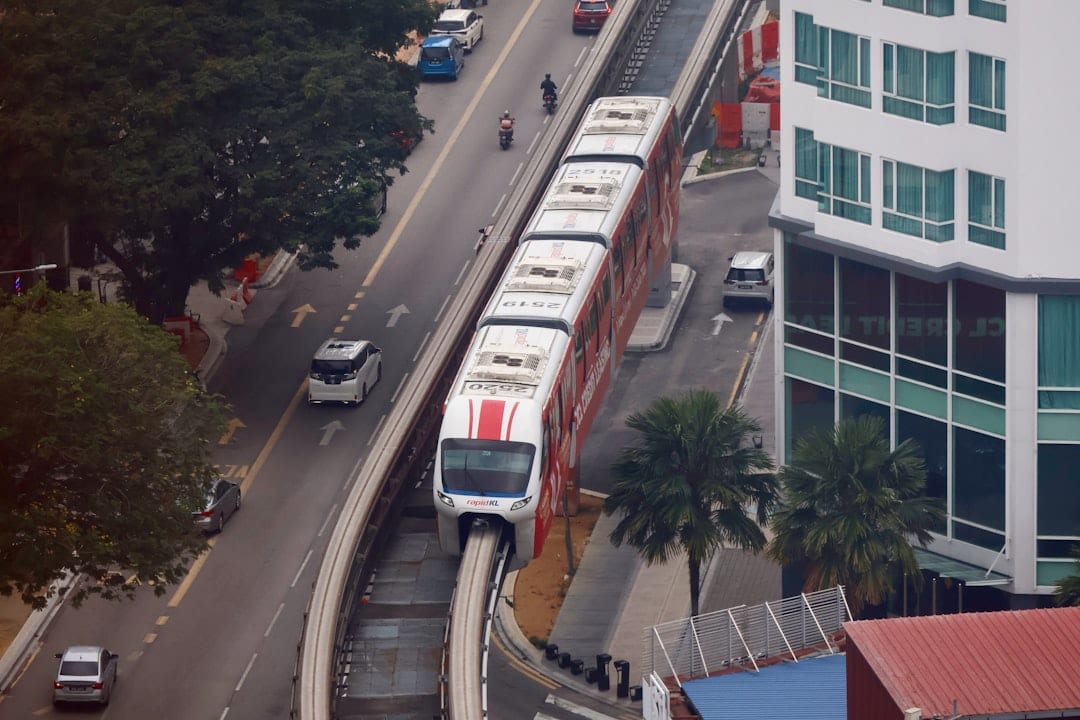
The Kuala Lumpur Monorail connects KL Sentral to Bukit Bintang and other central districts.
KLIA vs. KLIA2: Know Your Terminal
This is where many first-timers trip up. Kuala Lumpur has two main passenger terminals separated by roughly two kilometers, and your transport experience shifts slightly depending on where you land.
KLIA (Main Terminal) handles full-service carriers like Malaysia Airlines and Cathay Pacific. The arrival hall is straightforward: immigration, baggage claim, then a single well-signed exit plaza. The KLIA Ekspres station sits one floor below arrivals, and the Grab pick-up zone is at Door 4, Level 1. Everything is compact and intuitive.
KLIA2 is the domain of AirAsia, Cebu Pacific, and other low-cost carriers. It is larger, busier, and structurally different. After immigration, you will walk through Gateway@KLIA2, a sprawling retail mall that connects the terminal to transport hubs. The KLIA Ekspres station is on Level 2 within the mall, while Grab pick-up is at Door 3 on Level 1 of the Domestic Arrivals area. If you arrive on an international flight and walk straight out to the international curb, you may wait in the wrong zone. Always confirm your pick-up door in the Grab app before heading outside.
"I landed at KLIA2 on a Cebu Pacific red-eye and wandered the mall for twenty minutes looking for the train. Head up to Level 2 inside Gateway@KLIA2—the station is tucked behind the food court, not on the ground floor."
— Mesho traveler, Manila to Kuala Lumpur, March 2026
Late-Night Arrivals and Safety Essentials
If your flight touches down after midnight, your options narrow—but you are never stranded. The KLIA Ekspres runs until 12:30 AM from KLIA and 12:15 AM from KLIA2. Airport buses typically cease operations around 12:00 AM to 1:00 AM depending on the operator.
After these windows, Grab remains your safest and most reliable option. The app works 24/7, and driver availability is generally strong even at 2:00 AM. If you are exceptionally unlucky and face a Grab shortage, use the official airport taxi counters inside the terminal—not the freelance touts who approach you near the exit doors. These counters issue fixed-price coupons based on your destination, removing any meter anxiety.
- Safety note: KLIA and KLIA2 are among the safest airports in Southeast Asia, but standard travel awareness still applies. Keep your phone charged, your hotel address written down (or screenshotted), and your luggage within arm's reach.
- Currency tip: There are Maybank and CIMB ATMs on the arrival level at both terminals. Withdraw RM 200–300 for transport and immediate expenses. Avoid the currency exchange booths near baggage claim—they tend to offer weaker rates than ATMs.
- Connectivity: Both terminals offer free WiFi for one hour. If you need longer, a local SIM with a tourist data plan costs RM 25–35 and can be purchased at kiosks near the exit.
Scams to Avoid at Kuala Lumpur Airports
Kuala Lumpur is not a high-scam city, but the airport arrival zone is one place where opportunists congregate. Here are the four situations to recognize and refuse.
- The "Fixed Price" Taxi Tout: A well-dressed man approaches you near the exit asking if you need a taxi. He quotes RM 150–200 for a trip that should cost RM 75. Politely say "No, thank you" and keep walking. Licensed taxis use meters or official coupon counters—never verbal roadside deals.
- The Meter Scam: You somehow end up in a regular taxi, and the driver claims the meter is "broken" or "not used at night." Insist on the meter, or exit the vehicle at the nearest safe spot. Better yet, skip street taxis entirely and use Grab.
- The "Helpful" Intermediary: Someone offers to book your Grab for you because "the app is complicated here." They then demand a RM 20 "booking fee" for something you can do yourself in thirty seconds. Trust your own thumbs.
- The Wrong Terminal Confusion: If you are meeting someone or your hotel offers a transfer, always confirm whether they are picking you up at KLIA or KLIA2. Drivers sometimes wait at the wrong terminal and then blame you for the delay.
The golden rule is simple: if it happens inside the terminal but outside an official counter or app, be skeptical. Kuala Lumpur's official transport infrastructure is excellent; you do not need middlemen.
Planning your Malaysia trip? Mesho Travel And Tours curates seamless Malaysia tour packages that include airport transfers, hotel bookings, and guided city orientations—so your first hour in Kuala Lumpur feels as familiar as your last.
Connecting to Major Hotel Districts
Once you reach KL Sentral or step out of your Grab, you still need to close the final kilometer. Here is exactly how to reach the three most popular neighborhoods for Filipino travelers.
Bukit Bintang (Shopping, Nightlife, Jalan Alor)
Bukit Bintang is Kuala Lumpur's answer to Makati's Poblacion—bright, busy, and unapologetically energetic. From KL Sentral, take the KL Monorail to Bukit Bintang Station. The journey takes roughly fifteen minutes and costs under RM 3. If you are coming direct by Grab, simply enter "Bukit Bintang" or your hotel name; most drivers know the major properties by heart.
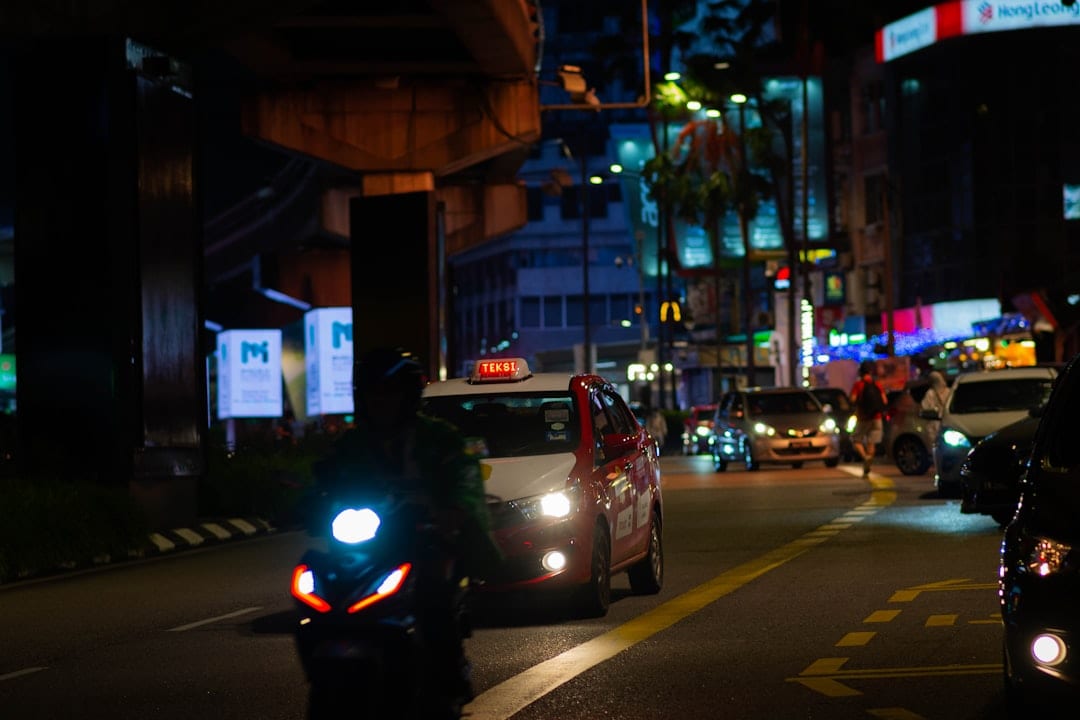
Bukit Bintang at night—home to Jalan Alor's famous hawker street and some of KL's best retail therapy.
KLCC (Petronas Towers, Upscale Malls)
If your hotel sits in the shadow of the Petronas Towers, the LRT Kelana Jaya Line is your best friend. From KL Sentral, board the train toward Gombak and alight at KLCC Station. It is a direct, elevated ride with a gorgeous skyline preview, and it takes about twelve minutes. By Grab from the airport direct to KLCC, expect to pay the standard RM 65–85 range.
Chinatown (Petaling Street, Budget Hostels, Heritage Eats)
Chinatown feels like a softer, more fragrant version of Binondo. From KL Sentral, take the MRT Kajang Line to Pasar Seni Station. Walk five minutes toward the covered arches of Petaling Street. Alternatively, the Grab ride from KL Sentral to Chinatown is short—usually RM 10–15—and spares you the stairs if you are hauling luggage over cobblestone paths.
Your First Hour in Kuala Lumpur: A Recap
- ✓ Pre-download Grab and link a card or GCash (via Alipay+) before departure.
- ✓ Know your terminal: KLIA for full-service carriers, KLIA2 for budget airlines—each has slightly different pick-up points.
- ✓ Choose your transport mode based on budget and group size: bus for savings, Ekspres for speed, Grab for convenience.
- ✓ Ignore freelance touts. Official counters and apps are the only transport sources you need.
- ✓ Have your hotel address ready in writing, and carry RM 50–100 in cash for tickets and tips.
Related Reading
- Malaysia Entry for Filipinos 2026: Visa-Free Stay, MDAC Requirements, and Immigration Tips
- Kuala Lumpur to Genting Highlands: A Filipino Family's Day-Trip Transport Guide
- Malaysia Week: A 7-Day Journey Through Kuala Lumpur, Penang and Langkawi
Ready to Experience Kuala Lumpur?
The journey from KLIA to your hotel is your first real taste of Malaysia—efficient, multi-layered, and surprisingly smooth once you know the ropes. Whether you are visiting for the street food, the skyline, or a longer Southeast Asia circuit, arriving with a plan changes everything.
Let Mesho Travel And Tours handle the details. From airport meet-and-greets to curated stays in Bukit Bintang and KLCC, we design Malaysia journeys that let you focus on the experience—not the navigation. Consult with our travel specialists today and step off the plane with confidence.
About the Author
Marco Dela Cruz is an ASEAN Travel Consultant at Mesho Travel And Tours, specializing in land, sea, and air routing for Filipino travelers exploring Southeast Asia. Based in Meycauayan, he has personally transited KLIA and KLIA2 more times than he can count—and still insists on the KLIA Ekspres when he is traveling solo.


